
Last Updated: November 10, 2026
Quick Summary
Welding safety equipment usually fails through simple wear, not faulty products. Heat and spatter stiffen gloves, UV and infrared degrade helmet lenses, and damp or crushed storage ruins shells and leather. Regular pre-use checks catch most of these problems early.
- Heat and spatter drive out leather oils, so a glove that feels rigid has lost its heat resistance.
- Yellowing, cloudiness or crazing on a helmet shell signals UV and infrared degradation.
- Store kit clean and dry, since damp leather grows mould and crushed shells lose their shape.
- Overhead welding needs extra checks: fastened sleeves, a snug helmet and a cap or flame-resistant liner.
- Replace any helmet lens that fails to darken or any glove that has split or hardened.
Table of Contents
- Why Welding Safety Equipment Fails More Often Than You Think
- The Most Common Causes of Welding PPE Failure
- Welding Helmet Maintenance: Keeping Your Eye and Face Protection Reliable
- Overhead Welding PPE: Extra Checks Before You Start
- Building a Welding PPE Inspection Checklist
- Welding PPE Replacement Signs You Should Never Ignore
- Equipment Failure Versus Incorrect Use and Your Legal Responsibilities in Great Britain
- Booking a Safety Equipment Review and Choosing Replacement Kit
- Frequently Asked Questions
Why Welding Safety Equipment Fails More Often Than You Think
Welding safety equipment fails more often than most workers expect, and the cause is usually simple wear, poor storage or a missed inspection rather than a faulty product. This guide explains why welding safety equipment fails, how to spot the warning signs early, and when to replace kit before it lets you down.
Welding exposes you to arc flash, UV and infrared radiation, sparks, hot spatter and fumes. That is why your welding safety equipment must work every time. When a helmet lens cracks or a glove loses its heat resistance, the protection you rely on is gone.
Here is what we cover:
- The most common causes of PPE failure
- How to maintain your welding helmet and face protection
- Extra checks for overhead welding
- A simple inspection checklist you can use before each job
- Signs that mean it is time to replace your kit
- Your legal responsibilities in Great Britain
The Most Common Causes of Welding PPE Failure
Most welding PPE fails for a handful of predictable reasons, and each one leaves a different signature.
Heat and spatter damage. Leather gloves and aprons are tanned and treated to resist heat, but repeated exposure to spatter drives out the oils that keep leather supple.
UV and infrared degradation. Arc radiation attacks polymers. Helmet shells, lens cover plates and the liquid-crystal layers in auto-darkening filters all degrade with exposure. The visible signs are yellowing, cloudiness, fine crazing on the shell and a lens that no longer clears fully.
Physical impact and poor storage. A dropped helmet can crack the shell or knock the headgear out of alignment without any obvious external damage.
Ageing materials. Even unused kit degrades. Elastomer seals harden, adhesives fail and flame-retardant treatments lose effectiveness over time, which is why manufacturer dates and batch records matter as much as visible condition.
Many failures are not sudden. Tracing these weak points back to the conditions that accelerate wear can also sharpen industrial welding failure analysis, since the same heat, exposure and handling patterns may contribute to premature weld problems.
Watch out: a glove or sleeve that has stiffened is not simply uncomfortable, the loss of suppleness is the visible sign that the heat-resistant treatment has broken down, and it should be treated as a failure rather than worn until it splits.
The table below summarises the main failure causes covered above, with the warning sign to watch for and the usual fix.
|
Cause |
Warning sign |
Fix |
|---|---|---|
|
Heat and spatter damage |
Gloves and aprons stiffen and micro-cracks open |
Replace; a stiffened glove has lost heat resistance |
|
UV and infrared degradation |
Yellowing, cloudiness, crazing or slow filter switching |
Replace the lens or filter |
|
Physical impact and poor storage |
Cracked shell, misaligned headgear, mould or crushed shape |
Remove from service and store clean and dry |
|
Incorrect selection and use |
Lens too light or filter mismatched to contaminant |
Reselect the product and retrain the user |
|
Ageing materials |
Hardened seals, failed adhesives, expired dates |
Replace by manufacturer date and batch record |
Welding Helmet Maintenance: Keeping Your Eye and Face Protection Reliable
Your helmet is the most important piece of welding safety equipment you own. Looking after it extends its life and keeps your eyes protected.
Start by cleaning the lens and shell after each shift with a soft cloth and a manufacturer-approved cleaner. Grit and spatter scratch the lens, which reduces visibility and can hide defects.
Routine helmet care:
- Check the auto-darkening lens for flickering, slow switching or dark patches.
- Look for cracks in the shell and the lens cover plates.
- Test the headgear straps and adjustment mechanisms.
- Replace cover plates before they become opaque or pitted.
- Keep the helmet out of direct sunlight and away from heat sources.
If your auto-darkening lens is worn or damaged, replace it with an exact replacement lens from Norsemen Safety rather than running a mismatched part. For a broader routine, our how should you maintain welding equipment in 2026? guide sets out maintenance habits that apply across your kit.
Overhead Welding PPE: Extra Checks Before You Start
Overhead welding brings extra risk. Molten spatter falls downward, often straight onto your face, neck and forearms.
Before you start overhead work, check these points:
- Confirm your helmet fits snugly and does not slide when you tilt your head back.
- Make sure your jacket or sleeves are fastened at the wrist and neck.
- Inspect your gloves for holes, thin patches and stiff areas.
- Wear a cap or flame-resistant liner underneath the helmet.
- Remove loose clothing and flammable items from your pockets.
These checks take a few minutes, but they stop the most common injuries from overhead work.
Building a Welding PPE Inspection Checklist
A written checklist turns good intentions into a habit. Use this list before each shift and record any faults.
- Helmet lens is clear, with no cracks, pitting or flicker
- Helmet shell and headgear are intact and adjust properly
- Cover plates are not cracked, scratched or fogged
- Gloves show no holes, burns or stiff, brittle areas
- Welding jacket or apron has no scorch marks or tears
- Respirator seals and filters are in date and fit correctly
- Ear protection is clean and in good condition
- Safety footwear has no damage to the toe cap or sole
Pin the checklist near your work area and review it weekly as well as before each job. Anything that fails the check should be removed from service straight away.
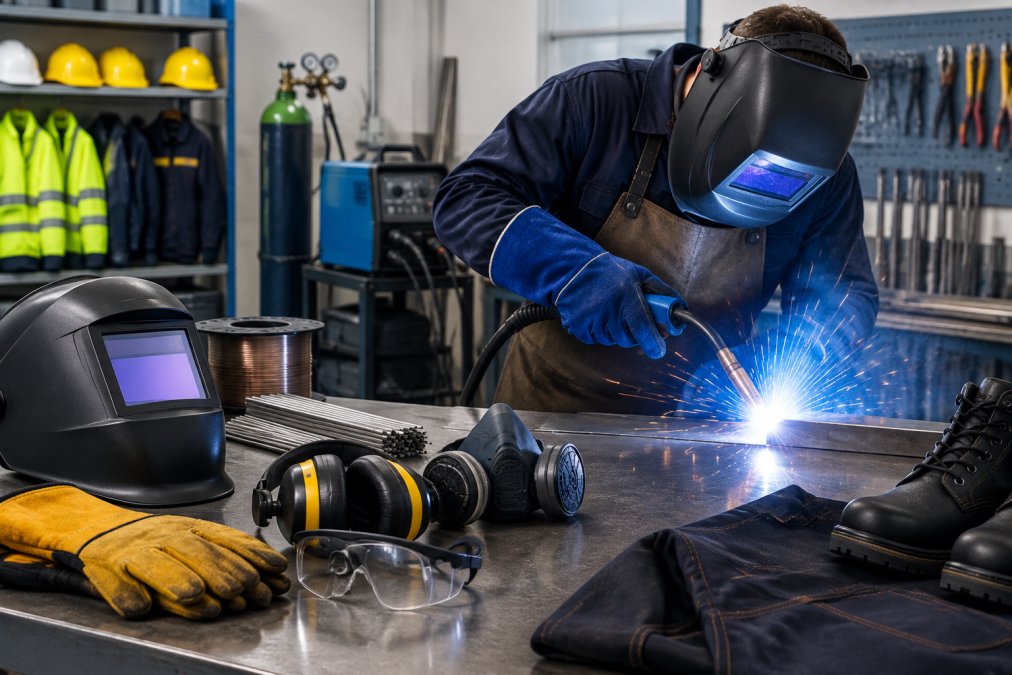
Welder inspecting welding safety equipment like gloves and a helmet on a workbench
Welding PPE Replacement Signs You Should Never Ignore
Some faults mean the kit must be replaced, not repaired. Do not keep using equipment that shows these signs:
- Cracks in the helmet shell or lens that could let spatter or arc light through
- An auto-darkening lens that fails to darken or switches unpredictably
- Gloves that have hardened, split or lost heat resistance
- Jackets with burn holes or thin patches that expose skin
- Respirators with damaged seals or filters past their service life
As a rule, if you are unsure whether a piece of kit still protects you, replace it. A few pounds spent on a new lens or pair of gloves costs far less than an eye or hand injury.
Equipment Failure Versus Incorrect Use and Your Legal Responsibilities in Great Britain
It helps to separate two problems, because they lead to different fixes. Equipment failure happens when a product is faulty, worn or damaged despite correct use, a lens that stops darkening, a glove that splits at a seam, a cable with cracked insulation. Incorrect use happens when the right product is used the wrong way, such as wearing a lens shade that is too light for the process, using a respirator filter matched to the wrong contaminant, or storing gloves damp so they stiffen.
In practice the two overlap. A glove worn past its service life is a failure, but continuing to wear it is a misuse. A helmet that fits badly because the headgear was never adjusted is a selection and fitting problem, not a defective product.
Employer duties. The Health and Safety at Work etc. The Personal Protective Equipment at Work Regulations 1992 set out the more specific duties: assess the risks, choose equipment that is suitable for the hazard, ensure it fits the wearer, provide information and training, and maintain it in efficient working order and good repair (Extended scope of the Personal Protective Equipment at Work Regulations). The Management of Health and Safety at Work Regulations 1999 require a suitable and sufficient risk assessment, which is where the choice of PPE and its inspection regime should be recorded (Risk assessment: Steps needed to manage risk).
What good practice looks like. A workable regime usually includes a written risk assessment that names the processes and the PPE selected for each; a pre-use check by the wearer; a periodic inspection at a defined frequency, recorded with the date, item and outcome; and a clear remove-from-service rule for anything that fails.
Worker duties. Workers must use PPE as trained and as instructed, take reasonable care of it, report defects and loss, and avoid misusing kit (Personal protective equipment at work).
Where to check the detail. The Health and Safety Executive publishes guidance on PPE selection, use and maintenance, and on welding fumes and respiratory protection, which is the practical reference for most fabrication shops. The Health and Safety Executive’s guidance on PPE is the starting point for the legal framework and the inspection expectations behind it.
Watch out: a risk assessment that lists PPE but not its inspection frequency and replacement criteria is difficult to defend after an incident, because it does not show that the equipment was kept in good repair as the regulations require.
Booking a Safety Equipment Review and Choosing Replacement Kit
When your kit shows wear, it is time to review your setup and replace what is no longer safe. Norsemen Safety supplies welding helmets, replacement lenses, protective gloves, workwear and safety footwear, and our team can help you match replacements to your processes. You can also browse our safety footwear range to find steel toe and slip-resistant options for your site.
If you are choosing a new helmet for your work, our professional welding helmet guide compares options for daily use. For respiratory protection, see our welding respirator selection guide before you buy.
Shop with Norsemen Safety to replace worn welding safety equipment and keep your workforce protected. Pricing depends on quantity, delivery and product choice, so check our website for current prices or request a quote.
Frequently Asked Questions
Why does welding safety equipment fail?
Welding safety equipment usually fails through a combination of normal wear, physical damage, heat and UV exposure, and poor storage or maintenance. Lenses crack or pit, harnesses and straps stretch, gloves harden and split, and electrical insulation on leads and helmets breaks down. Failures are often gradual, so a visual check at the start of each shift catches many problems before they become dangerous. Keeping a simple log of inspections and replacing items at the first sign of defect is the most practical way to reduce risk.
How often should welding PPE be inspected?
Welding PPE should be checked before every use with a quick visual inspection covering helmets, lenses, gloves, jackets and respiratory kit. A more thorough inspection by a competent person should be carried out at planned intervals, based on how heavily the equipment is used and the conditions it works in. Records of inspections help show that the process is followed, which supports compliance with the Personal Protective Equipment at Work Regulations 1992.
How can you tell if a welding helmet is no longer safe?
Look for cracks, chips or deep scratches in the lens, a helmet shell that is warped or brittle, loose or worn headgear, and any sign that the auto-darkening filter no longer switches correctly. If the shade does not change when the arc strikes, or flickers, the helmet should be removed from service. Light leaking around the edges or a lens that has become hazy and hard to see through also indicate that replacement is needed. Never repair a damaged helmet with makeshift parts.
What should you do if welding PPE is damaged?
Take damaged PPE out of use immediately and label it so nobody else picks it up. Report the defect to your supervisor or safety lead and record it. Replace the item with a suitable, undamaged piece rather than patching it. Where a fault suggests a wider problem, such as a batch of gloves splitting in the same way, check other items from the same supply. Keep the faulty item for review if it may help identify the cause of failure.