
Last Updated: November 19, 2026
Quick Summary
To prevent welding fumes at work, remove coatings before welding, choose lower-fume processes and consumables, and use local exhaust ventilation close to the arc. Respiratory protection is the last line of defence, not a replacement for these controls.
- Grind, blast or strip paint, primer and plating from the weld zone before you start
- Use solid wire where possible, as it usually gives lower fume than flux-cored wire
- Place extraction inlets within a few centimetres of the arc, ideally one hood diameter away
- Never position a hood behind the welder or above head height
- Get a face fit test for tight-fitting respirators and repeat it if the model changes
Table of Contents
- Why Welding Fumes Are a Health Risk in UK Workshops
- Identifying Hazardous Fumes and Gases Before You Weld
- Preparing the Work Area and Removing Coatings Before Welding
- Choosing Lower-Fume Processes and Consumables
- HSE Welding Fume Regulations: What Your Workplace Must Do
- Welding Fume Extraction Systems and General Ventilation
- RPE for Welding: Choosing, Fitting and Limiting Respirators
- Booking a Fume Control Review and Stocking Compliant Kit With Norsemen Safety
- Frequently Asked Questions
Why Welding Fumes Are a Health Risk in UK Workshops
Welding fumes are tiny metal particles and gases that form when metal heats up. Breathing them in can harm your lungs and wider health. Many workshops treat fumes as a minor nuisance, but long exposure adds up.
Fume is made of particles so small they reach deep into the lungs. The mix depends on the metal, the coating, the process and the consumable used. Stainless steel, galvanised metal and painted surfaces all create their own hazards.
Watch out: clear workshop air does not prove the air is safe. Fumes are often invisible at the welder’s breathing zone.
Identifying Hazardous Fumes and Gases Before You Weld
Before you strike an arc, know what you are working with. Check the material, any coating and the consumable you plan to use.
- Check the base metal, including whether it is galvanised or stainless
- Look for paint, primer, plating or oil on the joint
- Read the consumable data sheet for listed fume components
- Note any shielding gas and the ventilation available
Ask your supplier for the safety data sheet. It lists the hazardous substances you can expect.
Preparing the Work Area and Removing Coatings Before Welding
Removing coatings first cuts the fume you create. Grind, blast or strip paint, primer and plating from the weld zone before you start. Work on clean metal wherever you can.
Clean the area well back from the joint, not just the spot you touch. Keep the bench tidy and move flammable materials out of the way. A clean, organised workspace makes extraction easier to position.
Choosing Lower-Fume Processes and Consumables
Process and consumable choice changes how much fume you make. Some options produce far less than others.
- Use solid wire where possible, as it usually gives lower fume than flux-cored wire
- Choose low-fume consumables rated for your base metal
- Match the process to the job, so you do not weld longer than needed
- Keep arc length and current within the manufacturer’s range
Lower-fume options do not remove the need for extraction. Combine them with the controls in the sections below.
HSE Welding Fume Regulations: What Your Workplace Must Do
Welding fume is covered by the Control of Substances Hazardous to Health (COSHH) Regulations 2002 in Great Britain. The Health and Safety Executive (HSE) sets out how employers must assess and control exposure, and it publishes detailed welding guidance. Read the current HSE guidance, as the rules and workplace exposure limits are updated over time. HSE welding fume guidance
In practice, you must assess the risk, prevent or control exposure, and check that controls work. Keep records of your assessment and review it when your process or materials change.
Welding Fume Extraction Systems and General Ventilation
Extraction removes fume before it reaches the welder’s face. Local exhaust ventilation (LEV) is widely regarded as an effective engineering control for welding fume in workshops. General ventilation, such as opening doors or running fans, dilutes fume but does not capture it at source, so it should support LEV rather than replace it.
Choosing the right extraction type
- On-torch extraction captures fume at the arc through a nozzle built into the torch. It suits MIG and TIG work in tight spaces where a fixed arm cannot reach.
- Extraction arms with a hood or slot inlet suit bench work and fixed stations. They work best when the hood is positioned so the fume plume is drawn away from the breathing zone.
- Downdraught benches pull fume through a grille in the bench surface. They suit small parts and repetitive work but are less effective for large fabrications.
- Mobile units with a flexible arm or hose suit site work and changing layouts. Check the airflow rating against the duty you need.
Positioning extraction close to the source
Place the inlet within a few centimetres of the arc, ideally no more than one hood diameter away. Capture falls off sharply with distance: doubling the distance from the source can cut capture efficiency dramatically. Angle the hood so it draws fume away from the welder’s face, not across it. For on-torch nozzles, check the nozzle sits close to the arc without obstructing the weld pool.
Watch out: a hood placed behind the welder or above head height will pull fume through the breathing zone before it captures it.
General ventilation and working outdoors
General ventilation helps dilute residual fume but is not a substitute for LEV. In a workshop, ensure a supply of clean make-up air so extraction does not starve the space. Working outdoors or with doors open improves dilution, but do not rely on it in still conditions or enclosed areas. Confined spaces need their own assessment (see below).
Checking whether your extraction is working
Extraction only helps when it runs well. Check it regularly and record the results.
- Confirm the fan runs and the filter is clean and correctly seated.
- Test that the hood or nozzle sits close to the arc and is angled correctly.
- Use a smoke tube or similar indicator to confirm airflow is drawing fume into the hood.
- Look for smoke drifting past the welder’s face or escaping the hood.
- Check hoses, ducts and seals for cracks or disconnections.
- Record checks and act on faults straight away.
A common pattern is treating extraction as set and forget. Filters clog, hoses crack and hoods get knocked out of position, so the system slowly stops capturing fume. LEV should be thoroughly examined and tested at regular intervals under HSE guidance, with records kept.
Confined spaces and when to stop
In tanks, vessels, pits or other confined spaces, ordinary LEV may be insufficient. Fume can accumulate and displace oxygen, and rescue arrangements are needed before work starts. If fume is visible, if extraction cannot be positioned effectively, or if the space has not been assessed, stop and reassess. Do not rely on RPE alone in a confined space.
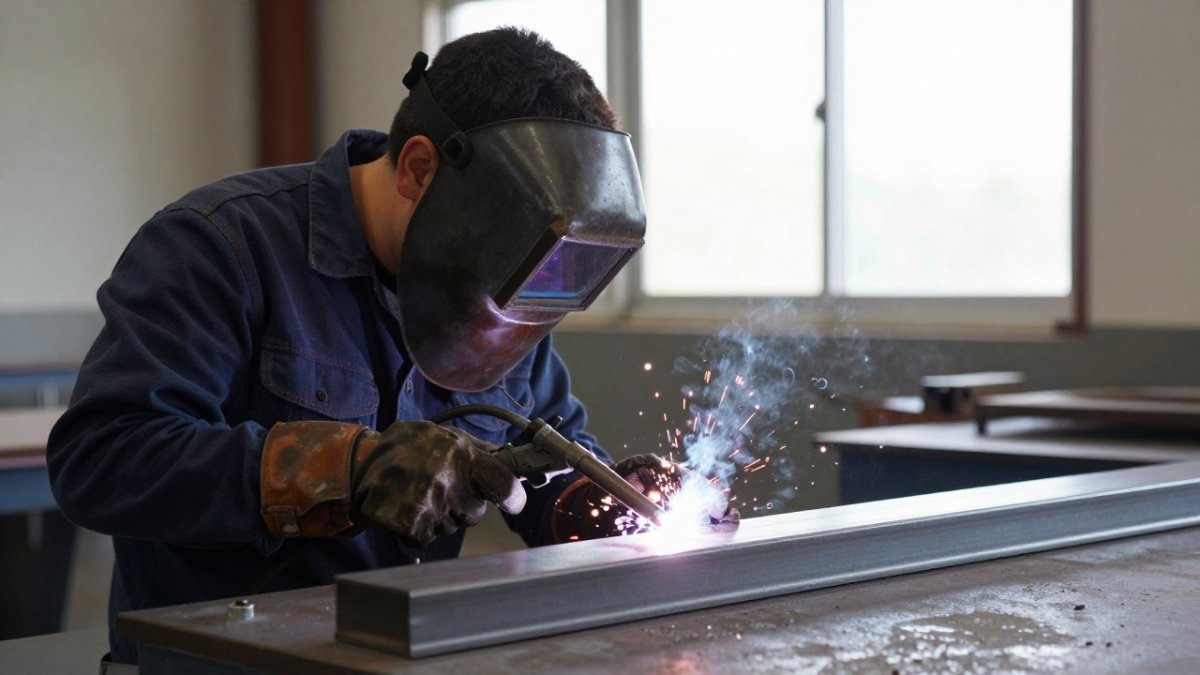
Shop welding fume extraction units. Compare fixed and mobile options against your workshop layout, and read the HSE guidance on LEV for examination and testing requirements.
The table below summarises the main extraction options and the checks that keep them working, as set out in this section.
| Option | Best for | Key point |
|---|---|---|
| On-torch extraction | MIG and TIG work in tight spaces | Captures fume at the arc |
| Extraction arm with hood | Bench work and fixed stations | Hood must draw fume away from the face |
| Downdraught bench | Small parts and repetitive work | Less effective on large fabrications |
| Mobile unit | Site work and changing layouts | Check airflow rating against the duty |
| Hood distance from arc | Any local exhaust set-up | Within a few centimetres, ideally one hood diameter |
| Hood position | Any local exhaust set-up | Never behind the welder or above head height |
| Smoke tube test | Checking capture is working | Confirms airflow draws fume into the hood |
| Confined spaces | Tanks, vessels and pits | Ordinary LEV may be insufficient; stop and reassess |
RPE for Welding: Choosing, Fitting and Limiting Respirators
Respiratory protective equipment (RPE) is the last line of defence, used when other controls do not reduce exposure enough. It must be selected for the hazard, fit properly and be worn correctly to work.
Choosing the right RPE
- Disposable filtering facepieces (FFP2 or FFP3) suit short-duration work with low fume levels, but the seal depends on a good facial fit.
- Half-mask respirators with particle filters suit longer welding tasks. Choose a filter rated for the fume and any gases present.
- Powered air-purifying respirators (PAPR) with a helmet or visor suit higher-exposure work and confined spaces, and they reduce breathing resistance.
- Supplied-air respirators suit the highest-risk or confined-space work where fume or gas levels are unpredictable.
Match the filter to the hazard: particle filters for metal fume, and gas or combined filters where shielding gases or coating breakdown products are present. Check the manufacturer’s assigned protection factor (APF) against the exposure you are trying to control.
Fit testing and facial fit
RPE only protects if the seal is tight. Get a face fit test for tight-fitting respirators, and repeat it if the model changes or the wearer’s facial features change. Keep facial hair clear of the seal. For PAPR and loose-fitting hoods, follow the manufacturer’s fitting instructions and check the airflow.
Watch out: a respirator that has not been fit-tested may leak badly without the wearer noticing.
Maintenance and replacement
- Replace filters on the manufacturer’s schedule, and sooner if breathing resistance rises.
- Store RPE clean and dry, and inspect it before each use.
- Clean reusable masks and check valves and seals.
- Record fit tests and maintenance.
Limitations: RPE never replaces source control
RPE limits exposure only while it is worn and fitted correctly. It does not remove fume from the workshop, and it offers no protection to others nearby. Use it alongside LEV, low-fume processes and clean materials, not instead of them. In confined spaces, RPE alone is not enough; additional controls and rescue arrangements are needed.
Read the HSE respiratory protective equipment guidance before choosing a model, and consider whether health surveillance is appropriate for your team.
You can book a fume control review type review, or start by reading our buy respiratory protection for welding guide. Our how to choose welding respirators for safety guide covers fit and selection in more depth, and our welding respirators range shows what is available.
Booking a Fume Control Review and Stocking Compliant Kit With Norsemen Safety
Fume control works best when every layer fits together: low-fume processes, clean material, working extraction and properly fitted RPE. Review your setup at least once a year, and after any change to materials, process or layout.
Norsemen Safety supplies welding equipment, PPE and industrial consumables across the UK and Ireland. Check current prices and availability on the website, as pricing depends on quantity and delivery. Shop welding fume extraction systems, or read our welding fume extraction guide to pick the right unit for your workshop.
Frequently Asked Questions
What are the HSE requirements for welding fume control?
Under the Control of Substances Hazardous to Health (COSHH) Regulations 2002, employers must assess welding fume risks, prevent exposure where reasonably practicable, and control it at source. Where control is not enough, suitable respiratory protective equipment must be provided. HSE guidance expects you to check that controls such as local exhaust ventilation work, to keep records of assessments, and to review them when the process or materials change. Exposure should be kept below the workplace exposure limits published by HSE.
How do I choose the right RPE for welding?
Start with your exposure assessment, because the fume level determines the protection factor you need. Filtering facepieces are suitable only for lower exposures, while powered or tight-fitting respirators suit higher levels. Choose equipment that has been fit tested for the individual wearer, and check that it suits the welding process and any shielding gases. Fit testing and replacing filters on schedule matter as much as the model you buy.
What is the difference between LEV and general ventilation?
Local exhaust ventilation (LEV) captures fume at or near its source, such as an extraction arm or on-torch nozzle, and removes it before it reaches the operator’s breathing zone. General ventilation dilutes airborne contaminants across the whole room and does not stop a welder breathing a concentrated plume. For most welding, LEV should be the primary control, with general ventilation supporting it rather than replacing it.
How often should welding fume extraction systems be tested?
LEV should be thoroughly examined and tested at regular intervals, more often where the risk justifies it. Checks should confirm that airflow at the capture point is adequate, that hoses and filters are intact, and that the system is maintained. Keep the written examination reports, and record any defects found and the action taken to fix them.