
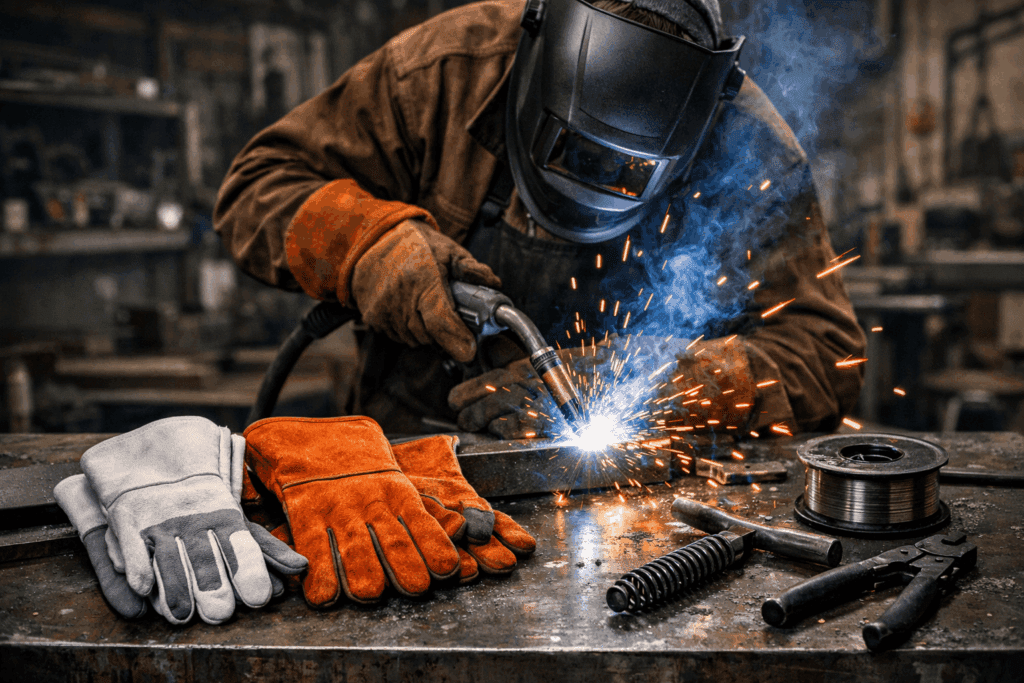
Welding gloves are one of the most essential pieces of personal protective equipment for any welder. Whether you are working with MIG, TIG, or stick welding, the right gloves protect your hands from heat, sparks, molten metal, and sharp edges.
However, not all welding gloves are the same. Different welding processes generate different levels of heat and require different levels of dexterity. A glove designed for heavy-duty stick welding may be too bulky for precise TIG work, while lightweight TIG gloves may not offer enough protection for high-heat MIG welding applications.
In this guide, we’ll explain how to choose the best welding gloves for MIG, TIG, and stick welding, what materials provide the best protection, and what features professional welders look for when selecting their gloves.
If you are looking for professional welding PPE, you can browse the full range of welding gloves available here.
Why Welding Gloves Are Essential
Welding generates extreme temperatures, bright arc radiation, and flying sparks that can easily cause burns or injuries if proper protection is not worn.
Quality welding gloves protect against:
- Radiant heat from the welding arc
- Molten metal spatter
- Sharp metal edges
- UV and infrared radiation exposure
- Abrasion and cuts
According to the Health and Safety Executive (HSE), appropriate hand protection is essential when working with hot materials and welding equipment.
Without proper gloves, welders risk burns, skin damage, and long-term exposure to harmful workplace hazards.
Key Features to Look for in Welding Gloves
Before choosing gloves for a specific welding process, it’s important to understand the features that make a welding glove effective.
Heat Resistance
Welding gloves must withstand extremely high temperatures without degrading or transferring heat to the skin.
Leather is commonly used because it provides natural heat resistance and durability.
Dexterity and Control
Certain welding processes require precise torch control and the ability to manipulate filler rods or small components.
TIG welding gloves are typically thinner to allow greater finger movement and dexterity.
Durability
Welding gloves must handle constant exposure to sparks, abrasion, and mechanical stress.
Reinforced stitching and durable leather construction significantly improve glove lifespan.
Comfort
Welders often wear gloves for long periods, so comfort is critical.
Features such as:
- Cotton linings
- Breathable materials
- Ergonomic designs
This can reduce fatigue during extended welding sessions.
Best Welding Gloves for MIG Welding
MIG welding produces moderate to high heat levels along with a significant amount of spatter. As a result, MIG welding gloves need to balance protection with flexibility.
Here’s our top 3 Best Mig Welding Gloves:
SpiderHand Mig Supreme Welding Glove – Quality, Comfort and Great Fit
Miller Universal Mig Welding Glove – Comfort and Durability
Weldas ComfoFlex Mig Welding Gloves – Good Heat Protection and Comfort
MIG welding gloves are typically:
- Thicker than TIG gloves
- More heat resistant
- Reinforced in high-wear areas
Common materials include:
- Cowhide leather
- Pigskin leather
- Split leather construction
These materials provide excellent durability while still allowing enough flexibility to control the welding torch.
Many professional MIG welding gloves also include padded palms and reinforced finger areas to protect against hot spatter.
If you regularly perform fabrication or structural welding, investing in durable MIG welding gloves can significantly improve both safety and comfort.
Best Welding Gloves for TIG Welding
TIG welding requires a much higher level of precision compared to other welding processes.
Because TIG welders must control both the torch and filler rod, dexterity becomes the most important factor.
Here’s our top 3 Tig Welding Gloves:
Miller Tig Welding Gloves – Great Dexterity and Good Value for the money.
Spiderhand Tig Supreme Welding Gloves – Available in a number of sizes to get the best fit.
Ejendals Tegera 7788 Tig Welding Glove – Great movement
TIG welding gloves are typically made from:
- Goatskin leather
- Deerskin leather
- Thin cowhide
These materials provide a soft, flexible feel that allows welders to manipulate filler rods with accuracy.
Unlike heavy-duty gloves used for stick welding, TIG gloves are designed to maximise movement and control.
However, because they are thinner, TIG gloves provide less heat resistance than MIG or stick welding gloves.
This is why TIG welding is often performed at lower amperages where extreme heat protection is not required.
Best Welding Gloves for Stick Welding
Stick welding, also known as MMA welding, produces extremely high temperatures and significant amounts of spatter.
As a result, stick welding gloves must prioritise maximum protection.
Our top 3 Choices for the Best Stick/Arc Welding Gloves
Tegera 19 Welding Glove – Quality and Great Protection
Tegera 8 Welding Gloves – Comfort and Quality
Weldas ComfoFlex 2000 Welding Glove – Available in sizes and good heat protection
Stick welding gloves typically feature:
- Thick leather construction
- Long protective cuffs
- Reinforced palms and fingers
- Heat-resistant lining
These gloves are designed to protect against molten metal droplets and intense radiant heat.
Many stick welders prefer gloves made from split cowhide leather because it offers excellent durability and heat resistance.
The extended cuff design also protects the wrists and lower forearms from sparks and hot debris.
Types of Leather Used in Welding Gloves
Leather type plays a major role in glove performance.
Each leather material offers different benefits depending on the welding process.
Cowhide Leather
Cowhide is one of the most commonly used materials for welding gloves.
Advantages include:
- High durability
- Excellent heat resistance
- Good abrasion protection
This makes cowhide ideal for MIG and stick welding gloves.
Goatskin Leather
Goatskin leather is softer and more flexible than cowhide.
It provides excellent dexterity while still offering good durability.
Because of this, goatskin is commonly used in TIG welding gloves.
Welding Glove Safety Standards
When purchasing welding gloves, it is important to choose gloves that meet recognised safety standards.
Many welding gloves comply with EN 12477, a European standard that specifies protective gloves for welders.
This standard categorises gloves into two types:
Type A – Higher heat protection but lower dexterity.
Type B – Greater dexterity but reduced heat resistance.
According to the European Committee for Standardization, these classifications help ensure gloves are suitable for different welding applications.
Understanding these standards helps welders choose gloves appropriate for their specific welding tasks.
How to Extend the Life of Welding Gloves
Even the best welding gloves will wear out over time, especially in high-heat environments.
Proper maintenance can significantly extend their lifespan.
Practical tips include:
- Keep gloves dry – Moisture can weaken leather and reduce heat resistance.
- Avoid excessive oil contamination – Oils and chemicals can degrade leather materials.
- Store gloves properly – Keep them in a dry environment away from direct heat sources.
- Replace worn gloves – If gloves become thin, cracked, or damaged, they should be replaced immediately.
Common Welding Glove Mistakes
Many welders unknowingly use the wrong gloves for their welding process.
Some common mistakes include:
- Using TIG gloves for heavy MIG welding – Thin gloves may not provide enough protection from spatter.
- Using oversized gloves – Loose gloves reduce control and increase accident risk.
- Ignoring worn-out gloves – Damaged gloves may no longer provide adequate heat protection.
- Using general work gloves – Standard work gloves are not designed for welding temperatures.
Following proper PPE guidelines ensures welders remain safe while maintaining good control over their work.
Choosing the Right Welding Gloves for Your Work
The best welding gloves depend on your welding process and working environment.
General recommendations include:
- For MIG welding – Choose durable leather gloves with good heat resistance and reinforced stitching.
- For TIG welding – Select thin, flexible gloves made from goatskin or soft leather for maximum dexterity.
- For stick welding – Use thick leather gloves with long cuffs for maximum protection.
Investing in high-quality welding gloves improves safety, comfort, and welding precision.
You can browse professional welding PPE and safety equipment here.
FAQ: Welding Gloves
What are the best gloves for MIG welding?
The best MIG welding gloves are typically made from cowhide or pigskin leather. They provide a balance of heat protection, durability, and flexibility.
Are TIG welding gloves different from MIG gloves?
Yes. TIG welding gloves are thinner and more flexible to allow precise control of the torch and filler rod, while MIG gloves are thicker to protect against heat and spatter.
Can you use TIG gloves for stick welding?
TIG gloves are generally too thin for stick welding. Stick welding requires thicker gloves that offer greater heat resistance and protection from molten metal.
How long do welding gloves last?
The lifespan of welding gloves depends on usage and heat exposure. Heavy fabrication environments may require frequent replacement, while occasional welding may allow gloves to last much longer.
What material is best for welding gloves?
Leather is the most commonly used material. Cowhide, goatskin, and pigskin are all popular choices depending on the welding process.
Final Thoughts
Choosing the best welding gloves for MIG, TIG, and stick welding is essential for both safety and performance. Each welding process produces different levels of heat and requires different levels of dexterity, making it important to select gloves designed specifically for the job.
MIG welding gloves offer a balance of protection and durability, TIG welding gloves provide precision and flexibility, and stick welding gloves deliver maximum heat resistance.
By investing in high-quality welding gloves and maintaining them properly, welders can protect their hands while improving comfort and control during every welding project.