
Quick Summary
Bulk welding supplies save contractors money by lowering the cost per weld and reducing the risk of running out mid-job. Buy enough of the consumables you use every week, such as MIG wire, electrodes and gas, while keeping stock moving so nothing sits unused past its useful life.
- Focus bulk buying on daily consumables such as MIG wire and contact tips, where stock-outs halt production.
- Calculate consumption from three months of records, dividing usage by working weeks, rather than relying on memory.
- Estimate wire needed by multiplying weld length by wire mass per metre, then adding a waste allowance.
- Compare suppliers on total cost of ownership, including delivery, stock-out costs and returns, not unit price alone.
- Place a trial order covering two or three months of consumption before committing to a larger volume.
Table of Contents
- Why Bulk Welding Supplies Pay Off for Contractors
- Welding Supplies Procurement Checklist for UK Contractors
- Estimating Bulk Welding Consumables for a Project
- MIG Welding Wire Bulk Options: Spool Sizes and Compatibility
- Welding Consumables Inventory Management on Site and in the Workshop
- Choosing a Supplier: Delivery, Returns and Account Support
- Placing Your First Bulk Order With Norsemen Safety
- Frequently Asked Questions
Why Bulk Welding Supplies Pay Off for Contractors
Buying bulk welding supplies for contractors is one of the simplest ways to cut cost per weld and reduce the risk of running out mid-job.
Bulk buying works best when it is matched to real consumption.
Three areas usually deliver the clearest return:
- Consumables you use daily, such as MIG wire and contact tips, where stock-outs halt production.
- Protective equipment that must be replaced regularly, such as gloves and helmet lenses.
- Standard sizes and specifications that let one order cover several jobs.
Pricing depends on quantity, delivery dates and the specific products you choose, so we recommend asking for a quote rather than relying on estimates.
Welding Supplies Procurement Checklist for UK Contractors
A checklist is only useful if it changes what you order.
Step 1, Build a consumable register. List every consumable and PPE item used on your last three jobs, grouped by process (MIG, TIG, stick, flux-cored, plasma cutting) rather than by job. For each line record the specification: wire diameter and classification, electrode type and size, gas mix and cylinder size, contact tip and nozzle part numbers, and PPE size. The output is a single register you can quote against and reorder from.
Step 3, Calculate consumption from records, not memory. Pull the last three months of issue logs or purchase records and divide by the number of working weeks. Where records do not exist, use the estimating method in the next section and refine it after one quarter. The output is a weekly consumption rate per line.
Step 5, Group the order by process and storage. Place all MIG consumables together, all stick electrodes together, and so on.
Step 7, Agree the review date. Set a date one quarter out to compare actual usage against the estimate and adjust reorder points.
A common mistake is ordering by job rather than by process.
The checklist runs as seven steps, each with a clear output that feeds the next.
| Step | What to do | Output |
|---|---|---|
| 1. Build a consumable register | List consumables and PPE from the last three jobs, grouped by process | A single register to quote and reorder from |
| 2. Reconcile against actual stock | Count shelf stock, note opened packs, flag items past useful life | True available-stock figure per line |
| 3. Calculate consumption from records | Divide the last three months of usage by working weeks | Weekly consumption rate per line |
| 4. Set reorder point and quantity | Weekly consumption × lead time, plus safety margin | Reorder point and order quantity per line |
| 5. Group the order by process and storage | Put MIG, stick and other consumables together | Comparable quotes and correct storage |
| 6. Confirm commercial terms in writing | Check unit price, breaks, delivery, VAT and returns window | Quote showing all terms |
| 7. Agree the review date | Set a date one quarter out and adjust reorder points | Named owner and scheduled review |
Estimating Bulk Welding Consumables for a Project
A simple estimate prevents both shortfalls and surplus. Start with the total weld length for the project, then convert it into wire or electrode demand using your own deposition rates. The formula is:
Consumable needed (kg) = Total weld length (m) × Wire mass per metre (kg/m) × (1 + waste allowance)
Allow a waste margin to cover spatter, start and stop losses, and trimming, and refine it from your own weld records.
Example: a project with 400 m of MIG weld, with an assumed wire consumption of 0.03 kg per metre and a 12 per cent waste allowance, needs roughly 13.4 kg of wire.
Track actual usage against the estimate for at least three jobs. If you consistently overrun, your allowance is too low. If you consistently have wire left over, you are holding too much stock.
MIG Welding Wire Bulk Options: Spool Sizes and Compatibility
MIG wire is the consumable most contractors buy in volume, and the choice of spool size affects both cost and workflow. Larger spools reduce changeover interruptions and usually lower the price per kilogram, but they need compatible feed equipment and a dry, clean storage area.
Mild steel MIG wire is available in several formats suited to bulk buying:
- Mild Steel Welding Wire, 5 kg spool (SG2, copper coated). Suited to smaller fabrication shops and mobile contractors who want a manageable stock size. The copper coating supports consistent feeding for mild and medium tensile steels.
- Mild Steel Welding Wire, 15 kg spool (SG2, A18). Suited to workshops with steady throughput. Available in common diameters for MIG feeding.
When choosing between sizes, check three things: the wire diameter your machine and liner handle, the spool size your wire feeder accepts, and how quickly you will use the wire before it degrades in storage. Copper-coated mild steel wire should be kept dry and sealed; humidity causes rust that disrupts feeding and weld quality.
A common mistake is buying a larger spool than the wire feeder or spool holder can take. Confirm compatibility before ordering.
Welding Consumables Inventory Management on Site and in the Workshop
Good inventory management keeps bulk stock useful. Without it, boxes get damaged, wire rusts, and staff reorder what is already on the shelf.
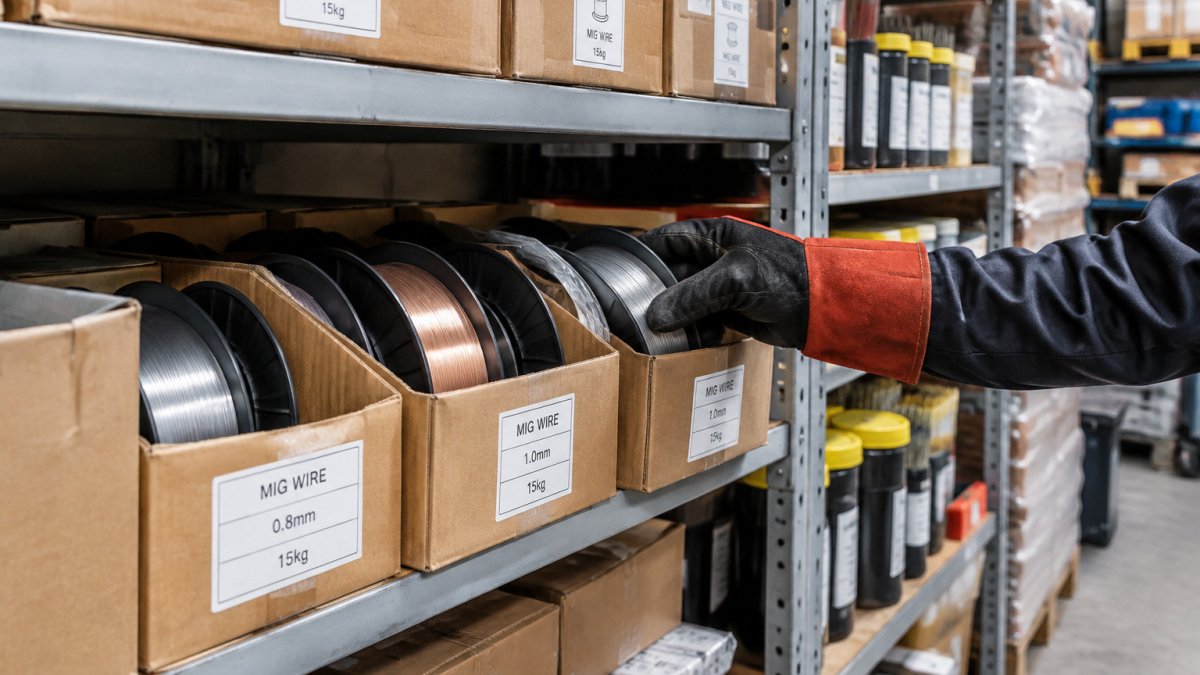
- Store by process and size. Label each shelf or bin with the wire diameter, electrode type or gas, and the reorder point.
- Keep wire dry. Store spools in sealed bags or a dry cabinet, away from the floor and from external doors.
- Use first-in, first-out. Rotate stock so older packs are used first, especially for coated electrodes that absorb moisture.
- Set reorder points. Reorder when stock falls to a level that covers your lead time plus a safety margin.
- Record usage. A simple log of what leaves the store each week gives you the data needed for the estimating method above.
On a live site, carry only one or two shifts’ worth of consumables and keep the rest in a secure store. This limits losses and keeps damaged or contaminated items out of the working area.
Watch out: electrodes left open in humid conditions can absorb moisture and cause porosity in the weld, so seal and store them according to the manufacturer’s instructions.
Choosing a Supplier: Delivery, Returns and Account Support
Price per kilogram is the easiest thing to compare and the least reliable guide to the real cost of a bulk order.
Build a supplier scorecard. Score each supplier out of five on the following, and weight the criteria to suit your work, a site contractor with tight programmes should weight delivery reliability heavily, while a fabrication shop with steady throughput may weight stock depth and technical support.
- Stock depth and continuity. Can the supplier hold your regular lines in the diameters and classifications you use, and will they tell you when a line is being discontinued rather than letting you discover it mid-job?
- Lead time and delivery reliability. Ask for the typical lead time and how reliably orders arrive on the promised day.
- Emergency replenishment. What is the process for an urgent order, what cut-off time applies, and is there a premium for it? A supplier who cannot answer this clearly will improvise when you need them most.
- Multi-site fulfilment. If you run several sites or vans, can the supplier deliver to each address, and how are split deliveries priced?
- Returns and warranty handling. What is the window for damaged or wrong-specification goods, who pays return carriage, and how quickly are replacements dispatched? Ask specifically about gas cylinders and opened consumable packs, which are often excluded.
- Technical support. Is there a named contact who understands your processes, or only a general helpdesk? For process selection and consumable matching, a knowledgeable contact saves more time than a small price difference.
- Account terms. Can you set up a trade account with agreed pricing, invoicing terms and a credit limit that suits your cash flow? Confirm whether payment terms change as order volume grows.
Test before you commit. Place a trial order covering two or three months of consumption with your shortlisted supplier and score the delivery, the paperwork and the returns process against the scorecard. A supplier who performs well on a trial order is a far safer bet for a larger commitment than one who only performs well in a sales conversation.
Watch out: a quote that excludes delivery, VAT treatment or returns cover can appear cheaper than a fully costed one, so read the full terms and ask for the exclusions in writing before comparing.
Norsemen Safety offers delivery across the UK and Ireland, a dedicated team for product and service support, and Buy Now, Pay Later options through PayPal. You can see our full range of welding consumables and PPE and check next-day delivery options for welding supplies before you place an order.
Placing Your First Bulk Order With Norsemen Safety
When you are ready to place your first bulk order, keep the process simple:
- Use the procurement checklist to list the consumables and PPE you need.
- Apply the estimating formula to set quantities, rounding up to standard pack sizes.
- Group the order by process so that stock is easy to store and reorder.
- Confirm delivery dates and the returns process before paying.
- Set reorder points for each item as soon as the stock arrives.
Start with a trial order covering two or three months of consumption. Once you have seen how quickly the stock moves and how the delivery performs, you can scale up with confidence. Shop Norsemen Safety’s bulk welding supplies to find the wire and consumables that match your processes, or contact our team for a quote on larger volumes.
Running a welding business means keeping the job moving, and that starts with stock on the shelf. Norsemen Safety supplies the welding consumables, PPE and industrial equipment contractors rely on across the UK and Ireland, with delivery options and support that understand how trade work runs.
Frequently Asked Questions
Which welding supplies do contractors commonly order in bulk?
Contractors most often buy in bulk the consumables they use daily: MIG welding wire, flux-cored wire, stick electrodes, shielding gas cylinders, contact tips and nozzles, grinding discs and PPE such as gloves and helmet lenses. Buying these in larger quantities usually lowers the unit cost and reduces how often a job stops for a supply run. Pricing depends on quantity, dates and delivery, so request a quote from Norsemen Safety for current figures before you plan your budget.
How should contractors estimate welding consumables for a project?
Start from the weld length and joint type in the drawings, then work out the deposition needed per metre. Add an allowance for spatter, stub ends, test pieces and rework, typically a margin you agree with your site or workshop lead. Multiply by the number of welders and the programme length, then check the figure against the wire or electrode pack size. Keeping a simple log from the first week lets you refine the estimate for later phases.
Which welding consumables have a limited shelf life?
Low-hydrogen stick electrodes are the most sensitive, because moisture absorbed from air can cause hydrogen cracking in the weld. They should be stored in a heated rod oven once the sealed pack is opened, as the manufacturer’s data sheet specifies. Flux-cored wire and some gas-shielded wires can also degrade if left exposed to damp. Check the batch date and storage instructions on each product before you order large volumes.
What should contractors look for in a welding supplies supplier?
Look for consistent stock of the specifications you use, clear product data including certification and compliance documents, and a team that can help you choose the right consumable for the process and material. Reliable delivery to your postcode area, a straightforward returns process for damaged or wrong-spec items, and account support for repeat orders all matter more than headline price alone. Norsemen Safety offers UK and Ireland delivery options and product support, and you can check current details on its website.