
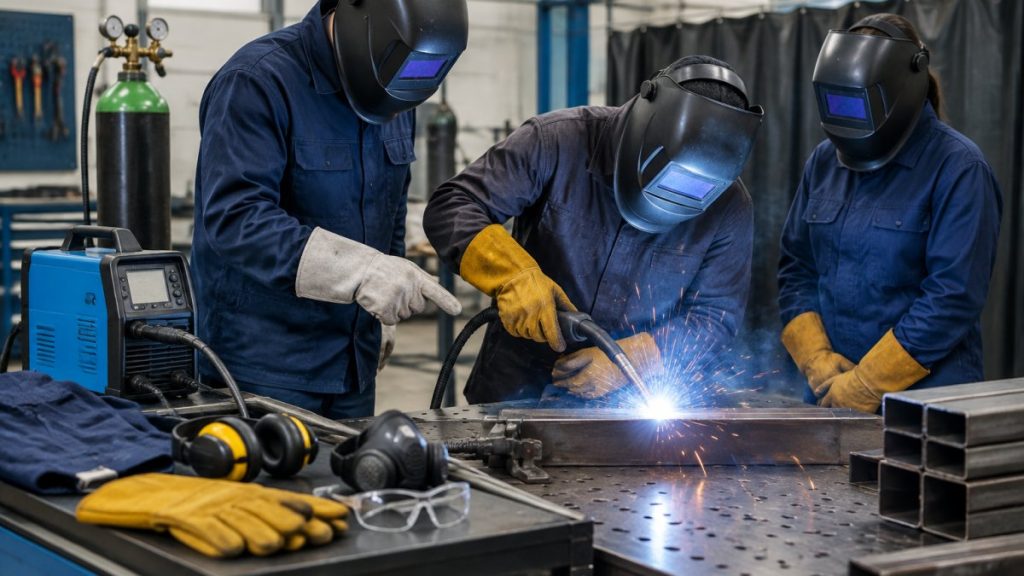
Last Updated: 2 November 2026
Quick Summary
Welding safety training for workers is a legal duty for employers in Great Britain, who must protect staff from fume, arc radiation, fire and electrical hazards. Training links the risk assessment to what workers actually do, and it must be backed by competence checks and dated training records.
- Employers must assess welding risks, then provide training that matches those specific hazards.
- Training counts as an administrative control, ranking below engineering controls such as local exhaust ventilation.
- Respirators need fit testing by a competent person, with results recorded.
- Helmet lenses should be replaced when scratched, pitted or spattered, not left in use.
- Keep the risk assessment, training content, attendance record and competence assessment together.
Table of Contents
- Why Welding Safety Training for Workers Is a Legal Duty
- Welding Hazards in the Workplace Every Worker Should Recognise
- Welding PPE Requirements: What Workers Must Wear and Why
- Welding Fume Control: Applying the Hierarchy of Measures
- Building a Welding Safety Checklist for Each Task
- Assessing Competency, Keeping Training Records and Responding to Incidents
- Booking Your Team’s Next Welding Safety Session
- Frequently Asked Questions
Welding safety training for workers is not optional in the United Kingdom. Employers have a legal duty to protect people from the hazards welding creates, and training is one of the main ways they meet it. Workers who know how to strike an arc often do not recognise what the arc is doing to the air around them. This guide sets out what training should cover, what the law expects, and how to build a programme that holds up in practice.
Why Welding Safety Training for Workers Is a Legal Duty
Employers in Great Britain must protect employees and others from risks to their health and safety, so far as is reasonably practicable (Health and Safety at Work etc Act 1974).
Training is part of the control measures, not an extra. A worker not trained to set up a workpiece safely or recognise a fume hazard has not been properly protected.
What the Employer Must Do
The legal duty breaks down into a sequence of practical steps, each feeding the next.
- Assess the risk. Identify the welding processes, materials, fume and radiation hazards, fire risk and electrical risk, and record who is exposed, including bystanders and nearby trades.
- Identify the controls. Set out the hierarchy: elimination or substitution, engineering controls such as local exhaust ventilation, administrative controls, then PPE last. Training is an administrative control.
- Provide information, instruction and training. Workers need to know the hazards, controls, safe system of work and emergency procedures, tailored to the tasks they actually perform.
- Supervise. Supervision confirms training has translated into safe behaviour; new or returning workers, and anyone in a confined space or on a new process, need closer supervision until competence is demonstrated.
- Record and review. Keep training records, assessment results and supervision notes, and review them when processes, equipment or personnel change.
What the Worker Must Do
Workers also have duties under the 1974 Act: to take reasonable care of themselves and others, co-operate with the employer on health and safety, and not interfere with or misuse anything provided for their protection. In welding terms, that means using the extraction, wearing the PPE provided, reporting damaged equipment, and following the safe system of work rather than improvising around it.
The Risk-Assessment-to-Training Link
The most common compliance weakness is a training programme not tied to the risk assessment. If the assessment identifies fume from galvanised steel as a significant hazard, training should cover the specific controls for that material, not just welding fume in general. If it identifies confined-space entry, training should cover permit-to-work arrangements, gas testing and rescue. An inspector will look for a clear line from the assessment through the training content to demonstrated competence.
Keep the risk assessment, training content, attendance record and competence assessment together so the connection is visible without reconstruction. Review the whole package when a process changes, new equipment arrives, or after any incident or near miss.
Welding Hazards in the Workplace Every Worker Should Recognise
Welding brings several hazards together at once, and the danger often lies in how they combine. Workers need to identify all of them before the first bead is laid.
Fumes, Gases and Arc Radiation
Welding fume is made of fine metal particles and gases produced when the base metal, filler and coatings are heated. Exposure depends on the process, materials and airflow through the work area.
Arc radiation is the other immediate concern. Ultraviolet and infrared light can burn eyes and skin within seconds, with damage often felt hours later as “arc eye”. Training should cover why bystanders need screens and why a worker should never look at an unshielded arc, even briefly.
Fire, Burns and Electrical Risks
Sparks, spatter and slag travel further than most people expect, igniting cardboard, oily rags, solvents and dust that seem too far away to matter. Hot-work controls, clearing combustibles, using fire blankets and assigning a fire watch after the job, should be routine.
Electrical risk comes from the welding circuit itself: damaged leads, poor earthing, wet floors and equipment left energised.
Welding PPE Requirements: What Workers Must Wear and Why
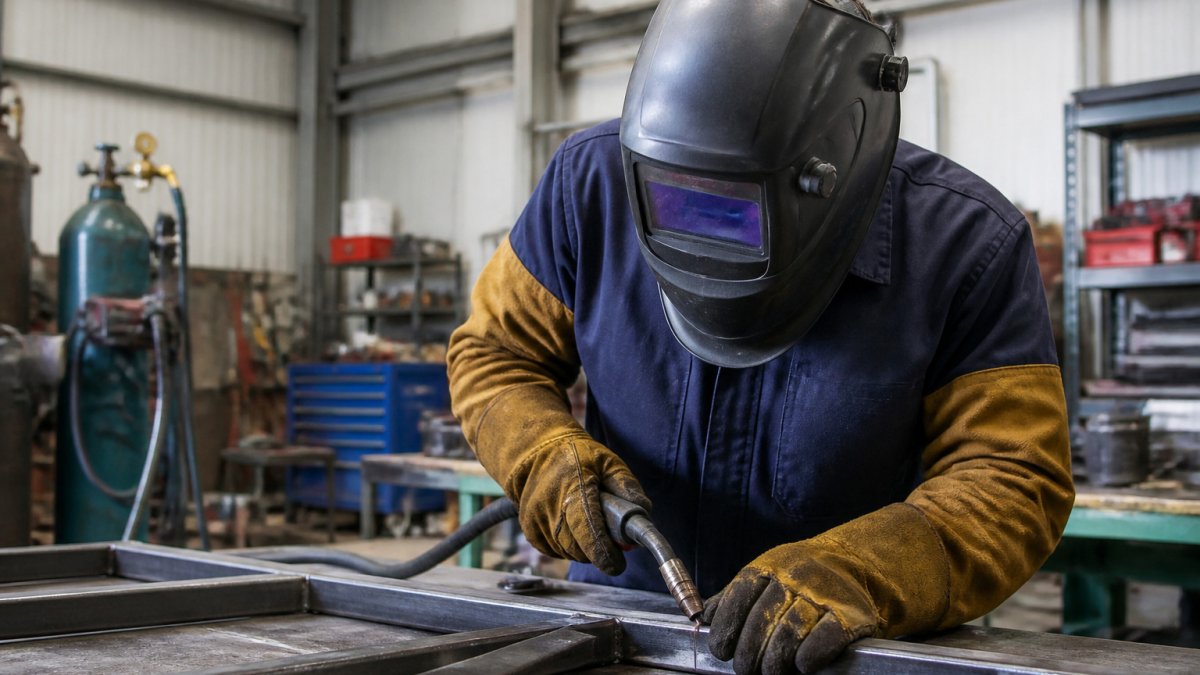
PPE is the last line of defence, used when risks cannot be removed or controlled at source, and it must be chosen correctly, worn properly and maintained. Under UK health and safety law, employers must provide suitable PPE free of charge, maintain it in efficient working order, ensure workers use it, assess it before selection, train workers in its use, and rectify any loss or defect (Extended scope of the Personal Protective Equipment at Work Regulations).
Selecting PPE by Process
The right kit depends on the process, amperage and position of the work. Selection usually follows the process, amperage and position of the work, as set out in the relevant HSE guidance:
- Manual metal arc (stick) welding. Higher amperage and heavier spatter call for a darker filter shade, thick leather gloves, a leather apron over flame-resistant overalls, and a helmet with a large viewing area. Chipping slag adds a need for eye protection under the helmet.
- MIG/MAG welding. Similar shade range but often a lighter, more dextrous glove for wire and torch control. Spatter is finer, so a flame-resistant jacket with a closed collar matters more than a heavy apron.
- TIG welding. Lower amperage and a cleaner arc allow a lighter shade and thin, heat-resistant gloves that preserve feel on the filler rod. The main risk shifts to UV exposure of arms and neck, so sleeves and a neck cover are essential.
Fit Testing and Respiratory Protection
Where fume controls cannot keep exposure below the workplace exposure limit, respiratory protective equipment (RPE) is needed, and it only works if it fits the wearer’s face (Fit testing basics). Tight-fitting respirators must be fit tested by a competent person, with results recorded. Workers with beards or facial hair in the seal area cannot achieve a reliable seal, so hoods or powered respirators may be the practical alternative.
Maintenance, Storage and Replacement Triggers
PPE that is dirty, cracked or past its service life offers false confidence. A simple maintenance routine keeps protection reliable:
- Helmets: replace the outer lens when scratched, pitted or spattered; check the headband and any auto-darkening battery each shift; store away from direct sunlight and heat. You can browse welding eye and face protection to find replacement lenses and helmets.
- Gloves: inspect for holes, stiffness or heat damage before each use; replace rather than repair. Shop welding gloves, helmets, boots and flame-resistant gear in one place.
- Flame-resistant clothing: check for oil contamination, which can make fabric flammable, and for worn patches at cuffs and knees.
Workers should be taught why each item matters, not just told to wear it. A welder who understands that synthetic clothing can melt onto skin is far less likely to wear it under a jacket on a warm day, and one who knows how a fit test works is more likely to report a mask that no longer seals.
Welding Fume Control: Applying the Hierarchy of Measures
The control hierarchy orders measures by effectiveness: eliminate the hazard, substitute a safer option, engineer the risk out, use administrative controls, and only then rely on PPE.
Local exhaust ventilation (LEV) is the most reliable engineering control: a capture hood or on-torch extraction removes fume close to the arc, before it reaches the welder’s breathing zone.
Substitution can also reduce exposure: choosing a process, consumable or base material that produces less fume is worth checking when the job allows.
The control hierarchy ranks the measures used for welding fume, from most to least effective.
|
Control measure |
Effectiveness |
How it works |
|---|---|---|
|
Elimination or substitution |
Highest |
Choose a process or material producing less fume |
|
Local exhaust ventilation |
Most reliable engineering control |
Removes fume close to the arc |
|
General ventilation |
Dilutes fume across the room |
Seldom protects the welder’s breathing zone |
|
Administrative controls |
Supports engineering measures |
Rotate tasks, limit welding time, keep others away |
|
Respiratory protective equipment |
Last line of defence |
Protects the wearer only and needs a proper fit |
Building a Welding Safety Checklist for Each Task
A task-specific checklist turns general training into something a welder uses before starting. It should be short enough to read at the bench and specific enough to catch that job’s risks. A workable checklist for a typical stick or MIG job includes:
- Work area cleared of combustibles within at least 11 metres, or screened and covered where clearance is not possible
- Fire extinguisher and fire blanket within reach, with a fire watch arranged for at least 30 minutes after completion
- Leads, holders and earth clamp inspected for damage before switching on
Adapt the list for confined spaces, outdoor work in wind, or site work where other trades are nearby. The point is that every welder runs through the same questions, every time.
Assessing Competency, Keeping Training Records and Responding to Incidents
Training is only meaningful if it leads to demonstrated competence. Observation on the job, a practical test of set-up and fault checking, and questions about the hazards and controls all provide evidence. Follow a step-by-step guide to verify that the PPE your workers use is compliant.
Keep records of who was trained, on what, when, by whom, and when the next review is due. These support compliance and show responsible management if something goes wrong. Review the programme periodically: near misses, inspection findings and worker feedback often reveal where training needs sharpening.
When an incident happens, first make the area safe and get medical help. Burns, eye injuries and fume-related symptoms should be assessed promptly, and the cause investigated.
Booking Your Team’s Next Welding Safety Session
Start with a gap check. Compare what each worker does now with the hazards and controls described above, and note where competence is missing or out of date. Then decide whether to run training in-house with your own assessors or book an external course for certification.
Equipment matters as much as the course. If your team’s helmets are worn, extraction is missing or gloves are the wrong type, training will not close the gap on its own.
Frequently Asked Questions
What should welding safety training cover?
Welding safety training should cover the hazards present on the job, including fumes, arc radiation, fire, burns and electrical risks. It should explain the PPE required for each task, how ventilation and extraction controls work, and the safe handling of gas cylinders. Workers also need to know the site’s hot-work permit process, how to inspect equipment before use, and how to report incidents and near misses. Training should be practical, with hands-on demonstration and a check that each worker can apply what they have learned.
Do workers need training before using welding equipment?
Yes. Under UK health and safety law, employers must make sure workers have the information, instruction, training and supervision needed to do their work safely. Anyone operating welding equipment should be trained on that specific equipment and process before they start, including setup, shutdown and emergency steps. Training alone is not enough on its own: the employer should confirm competency through supervised practice and keep a record of it.
How often should welding safety training be refreshed?
There is no fixed interval set in law for welding safety refresher training, so employers should decide frequency through their risk assessment. Refresher training is sensible after a change in equipment, process or materials, after an incident or near miss, when a worker has been away from welding for a long period, or at regular intervals set by the business. Many employers review competency annually as a baseline and update it whenever task risks change.
What are the main hazards workers face when welding?
The main hazards are welding fumes and gases, which can affect the lungs and can cause longer-term health problems; arc radiation, which damages eyes and skin; sparks and hot metal, which cause burns and fires; electric shock from damaged leads or poor earthing; and gas cylinder risks such as leaks or falls. Workers in confined spaces face additional risks from restricted airflow. A proper risk assessment should identify which of these apply to each task and set out controls for them.