
Last Updated: November 8, 2026
Quick Summary
Welding sites in the UK must comply with the Health and Safety at Work etc. Act 1974, supported by more specific regulations such as the Management of Health and Safety at Work Regulations and COSHH. Each welding job needs its own risk assessment, covering fume, fire and other hazards, before work starts.
- A specific risk assessment should be written for each welding task, not one site-wide assessment.
- COSHH assessments must cover welding fume, consumables and any coatings on the metal.
- Local exhaust ventilation should capture fume at source, close to the arc.
- A hot-work permit should be time-limited, with a named fire watch and a post-work check.
- Anyone who welds or supervises welding needs training, shown through demonstration and assessment.
Table of Contents
- Which HSE Regulations Apply to Welding Sites
- Welding Risk Assessment: Identifying Hazards Before Work Starts
- COSHH Assessment for Welding and Hazardous Substances
- Welding Fume Control: Ventilation, RPE and Monitoring
- Permit-to-Work, Hot Work and Fire Precautions on Site
- Welding Safety Training and Competence Requirements
- Building Your Site Compliance Checklist and Next Steps
- Frequently Asked Questions
Which HSE Regulations Apply to Welding Sites
Welding sites in the UK fall under the Health and Safety at Work etc. Act 1974, which places a general duty on employers and the self-employed to keep people safe. Several more specific regulations then apply depending on the work. The Management of Health and Safety at Work Regulations require a suitable and sufficient risk assessment, while the Control of Substances Hazardous to Health Regulations (COSHH) cover fumes and gases. Personal protective equipment and workplace ventilation, lighting and housekeeping are also covered by further regulations, which your risk assessment should identify for your site.
Working at height, in confined spaces, and around flammable materials brings in further duties. Our advice is to map the regulations to each job before work begins, not after an incident. Guidance is published by the Health and Safety Executive’s welding guidance, which is the best starting point for checking current requirements.
Watch out: many sites assume a single site-wide risk assessment covers every welding task. It rarely does, because each job changes the hazards.
Welding Risk Assessment: Identifying Hazards Before Work Starts
A welding risk assessment identifies what could harm people during a specific task, then decides what controls to put in place. Start by listing the hazards: fumes, UV radiation, sparks and spatter, heat, electrical risk, noise, and fire. Then note who is exposed, how often, and for how long.
The assessment should be written down, reviewed when the job changes, and shared with everyone on the team. Include the welding process, the materials, the location and the duration. A mobile repair on a farm needs a different assessment from a fixed bay in a fabrication shop.
For the principles behind a sound assessment, the HSE’s five steps to risk assessment set out a clear method that most welding businesses can adapt.
COSHH Assessment for Welding and Hazardous Substances
Welding fume is a complex mixture, not a single substance. Mild steel fume is largely iron oxide, but it also carries manganese and other trace metals, and the gases produced include ozone and oxides of nitrogen, with carbon monoxide and shielding-gas displacement adding further risk in enclosed areas. Stainless and other alloyed steels introduce chromium and nickel compounds, and welding or cutting painted, coated or contaminated metal can release substances that are far more hazardous than the base metal suggests. Because the hazards vary with the metal, coating and working environment, structural steel welding safety depends on matching controls to the specific task and exposure.
The assessment should record the process, the base material, the consumable, any coatings or surface contamination, the location, the duration and the people exposed. Safety data sheets for consumables and any paints, solvents or degreasers in the area are the starting point, but they do not tell you what is in the fume, that comes from the process and the material. Where exposure could be significant, air sampling gives you a measured picture rather than an assumption.
Controls follow the hierarchy: eliminate or substitute where you can (for example, using a lower-fume process or removing coatings before welding), then engineer controls such as local exhaust ventilation, then organise the work to reduce exposure, and use RPE only as a supplementary measure where the other controls cannot bring exposure down far enough. Workplace exposure limits for the substances in the fume are set out in the HSE publication EH40, which is revised regularly, so check the current edition rather than relying on an old copy.
Record the substances, the routes of exposure, the control measures, the monitoring you carry out and the date of the next review. Review the assessment whenever you change consumables, materials, coatings or working methods, and keep a copy available for workers to read. Health surveillance may be appropriate where exposure to specific substances cannot be adequately controlled, and the assessment should say whether it is needed.
Watch out: a COSHH assessment copied from another site or another process is worse than none, because it gives false assurance, the fume profile changes with the material, the consumable and the coating, so the assessment has to match the job in front of you.
Welding Fume Control: Ventilation, RPE and Monitoring
Control fume at source wherever you can, using local exhaust ventilation positioned close to the arc. General ventilation dilutes fume across a space, but it does not replace extraction at the point of welding. Where extraction cannot fully control exposure, respiratory protective equipment (RPE) is required as a supplementary measure. Select RPE that fits properly and is suitable for the fume, and provide training on fit testing, storage and maintenance.
Monitoring confirms that controls are working. Check extraction performance, inspect filters and hoses, and where exposure may be significant, arrange air sampling. Keep records of checks so you can show evidence of control.
Consider matching your gear to the job, so that the equipment you choose reflects the controls your assessment calls for.
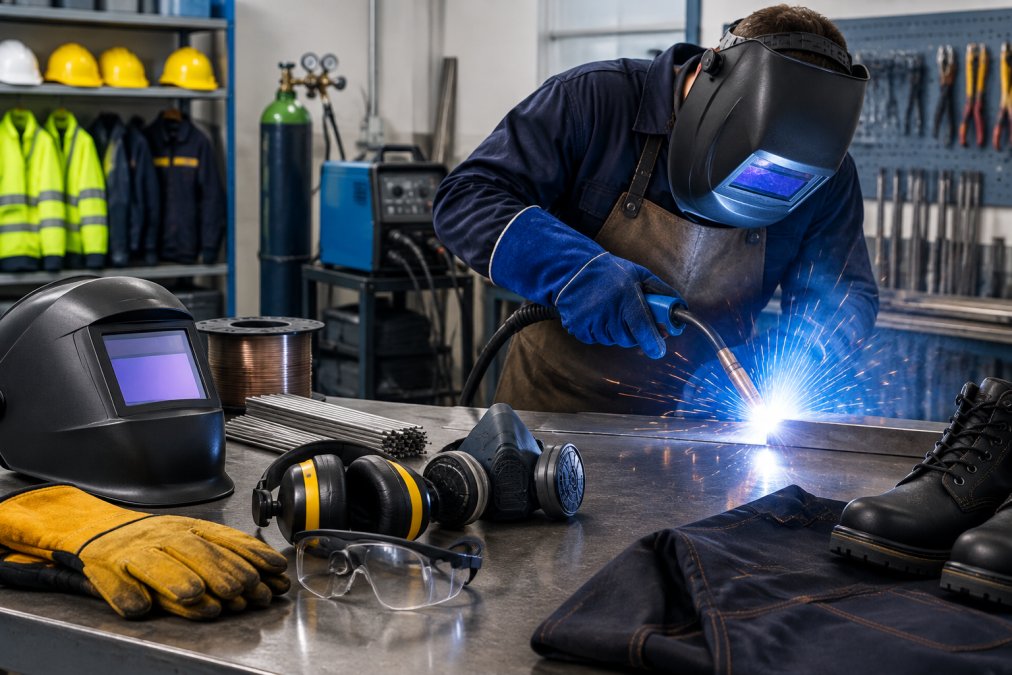
Welder wearing a respirator at one of the welding sites with local exhaust ventilation in use
The article sets out the main controls for welding fume, in order of preference.
|
Control |
Role |
Key point |
|---|---|---|
|
Local exhaust ventilation |
Captures fume at source |
Positioned close to the arc |
|
General ventilation |
Dilutes fume across the space |
Does not replace extraction at the point of welding |
|
Respiratory protective equipment |
Supplementary measure |
Must fit properly and suit the fume |
|
Air sampling |
Confirms controls are working |
Used where exposure may be significant |
|
Records of checks |
Evidence of control |
Covers extraction, filters and hoses |
Permit-to-Work, Hot Work and Fire Precautions on Site
Hot work, welding, cutting, grinding and any task that produces heat, sparks or flame, is one of the most common causes of serious fires on construction and industrial sites, and a permit-to-work system is the usual way to control it. The permit is not a formality: it is a written record that the area has been checked, the controls are in place, and someone with authority has agreed the work can start.
A workable hot-work permit records the location and description of the task, the person carrying it out, the date and time limits, the fire precautions taken, the name of the fire watch, and the signature of the person authorising the work.
The fire watch is a named person whose only job during the work is to watch for ignition and be ready to raise the alarm and use first-aid firefighting equipment. The role continues after welding stops: a common pattern is a post-work check at intervals for at least an hour after the last hot work, because smouldering material can take time to show. The permit should not be closed until that check has been done and recorded.
Coordination with other trades matters as much as the permit itself. Hot work in an area where others are using solvents, paints, foams or dusts creates a fire and fume risk that neither trade sees on its own, so the permit system should require the area to be checked and other affected trades informed before work starts.
Emergency arrangements should be agreed with everyone on site before work begins: how to raise the alarm, where extinguishers and hose reels are, where to muster, and who calls the emergency services. The HSE guidance on hot work and fire safety sets out the principles, and the site’s own fire risk assessment should reflect the hot-work activities taking place.
Watch out: the most common failure is a permit issued at the start of the shift and treated as cover for the whole day, the area changes, other trades move in, and the controls that were checked at 8am no longer match the job at 3pm, so the permit should be time-limited and re-checked when conditions change.
Welding Safety Training and Competence Requirements
Anyone who welds, supervises welding or assesses welding work needs training suited to the process and the setting. Training should cover hazard recognition, control measures, correct use of PPE and RPE, and emergency procedures. Competence is shown by demonstration and assessment, not by a certificate alone.
Refresh training when processes, equipment or regulations change, and keep records of who has been trained and when. Supervisors should understand the assessment and be able to stop unsafe work.
Building Your Site Compliance Checklist and Next Steps
Use a short checklist before each job and keep it with the permit:
- Risk assessment completed and reviewed for this specific task
- COSHH assessment covers consumables and coatings
- Extraction or ventilation in place and checked
- RPE selected, fitted and in good condition
- Gloves, eye protection and protective clothing issued
- Hot work permit issued and fire watch arranged
- Gas cylinders secured and equipment inspected
- Workers trained and competent for the task
Keeping this list consistent across every job makes compliance easier to prove. Norsemen Safety supplies welding equipment, consumables and PPE for UK and Irish sites. Pricing depends on quantity, dates and delivery, so visit our website for current prices and availability, or contact us for a quote.
Frequently Asked Questions
What health and safety regulations apply to welding sites?
The core UK duties come from the Health and Safety at Work etc. Act 1974 and the Management of Health and Safety at Work Regulations 1999, which require employers to assess risks and manage them. Welding is also covered by COSHH for hazardous fumes and gases, the Personal Protective Equipment at Work Regulations 1992, and any equipment and flammable-gas regulations that apply to your work. Check HSE guidance for the specific tasks on your site.
Does welding require a COSHH assessment?
Yes, where welding produces fume, dust or gases that could harm health, a COSHH assessment is required under the Control of Substances Hazardous to Health Regulations. The assessment should identify the substances present, such as metal fume and shielding gases, estimate exposure, and record the control measures in place. Review it when the process, materials or site conditions change, and keep it accessible to workers.
What PPE should welders wear on site?
Typical PPE for welders includes flame-resistant clothing, leather gloves, safety boots, eye and face protection suitable for the process, and hearing protection where noise is high. Respiratory protective equipment is needed where ventilation cannot control fume to acceptable levels. Choose equipment to the relevant British or European standard, fit-test RPE, and replace damaged items promptly. Pricing for specific products depends on quantity, dates and delivery; visit the Norsemen Safety website for current prices or a quote.
What training do welders need for health and safety?
Employers must ensure welders are competent for the work they do. This means training in the process, safe use of equipment and gases, fume and hazard awareness, correct PPE use, fire precautions and emergency procedures. Competence is shown through practical assessment as well as certification where a scheme applies. Refresher training should follow changes in process, equipment or site rules, and training records should be kept on file.
What fire precautions are needed for hot work?
Hot work such as welding and cutting needs a risk assessment, a clear permit-to-work system where your site uses one, removal or protection of combustibles within a safe distance, a fire watch during work and after completion, and suitable extinguishers within reach. Gas cylinders should be stored upright, secured and separated from heat sources. Confirm the arrangements with the site fire risk assessment required under fire safety law.
How often should welding equipment be inspected?
Inspection frequency depends on the equipment, how often it is used and the conditions it is used in. Work equipment regulations require equipment to be maintained in efficient working order, and lifting or pressure-related equipment may need periodic thorough examination. Set a documented schedule based on your risk assessment, check leads, hoses and regulators before each shift, and remove faulty equipment from use immediately.