
Last Updated: 26 November 2026
Quick Summary
For most MIG welding on mild steel, pure argon gives a smooth, low-spatter arc but penetrates less, while pure CO2 penetrates deeper and costs less per litre but spatters more. Argon/CO2 blends sit between the two and suit most general fabrication work.
- Pure argon gives a stable arc and low spatter but costs more and penetrates less.
- Pure CO2 penetrates deeply and has the lowest cost per litre, but spatters more.
- Use argon-rich blends on thin sheet up to about 3 mm to limit burn-through.
- Stainless steel and aluminium should not be welded with pure CO2.
- Log cylinder changes and cleanup hours over several weeks to find your true running cost.
Table of Contents
- How to Choose Between Argon and CO2 for MIG Welding
- Argon vs CO2 for MIG Welding: What Each Gas Does
- How Shielding Gas Affects Arc Stability, Spatter and Bead Appearance
- MIG Welding Gas for Mild Steel: Penetration, Heat Input and Cost
- Best Gas for MIG Welding Stainless Steel and Aluminium
- MIG Welding Gas Flow Rate, Regulator Settings and Troubleshooting
- Gas Consumption, Running Cost and Indoor Versus Outdoor Use
- Choosing the Right Shielding Gas for Your Next Job
- Frequently Asked Questions
How to Choose Between Argon and CO2 for MIG Welding
Choosing a shielding gas is one of the first decisions that shapes the quality of a MIG weld. For most UK fabrication work on mild steel, the choice comes down to pure argon, pure CO2, or an argon/CO2 blend.
Pure argon gives a stable, smooth arc with low spatter, but it penetrates less and costs more per cylinder. For a closer look at how aluminium welding differs from steel and whether TIG or MIG suits that metal better, see the comparison page.
Argon vs CO2 for MIG Welding: What Each Gas Does
Shielding gas protects the molten weld pool from oxygen and nitrogen in the air. Argon is an inert gas, so it does not react with the weld. CO2 is an active gas that takes part in the arc chemistry, which is why it behaves differently.
Pure argon, pure CO2 and argon/CO2 blends explained
- Pure argon: Smooth, quiet arc. Low spatter. Shallow penetration. Best suited to thin material and non-ferrous metals.
- Pure CO2: Deep penetration and a hotter, more forceful arc. Higher spatter. Lowest cost per litre.
- Argon/CO2 blends: Commonly argon-rich with the balance CO2. They combine a steadier arc with reasonable penetration and moderate spatter.
Pros and cons at a glance:
- Argon: Pro: clean, stable arc and neat bead. Con: higher cost and weaker penetration on thick steel.
- CO2: Pro: deep penetration and lower cost. Con: more spatter and extra cleanup time.
How Shielding Gas Affects Arc Stability, Spatter and Bead Appearance
The gas you choose sets how easily the arc is controlled. Argon-rich mixes give a softer, more predictable arc, which suits welders who are still developing their technique. Pure CO2 produces a harsher arc that drives the wire harder into the joint.
Spatter is the most visible difference. Pure CO2 leaves more droplets on the workpiece and nozzle, so expect more grinding and cleanup afterwards.
Bead appearance follows the same pattern. Blends tend to give a flatter, more even bead with a clean toe, which helps where the weld is visible.
MIG Welding Gas for Mild Steel: Penetration, Heat Input and Cost
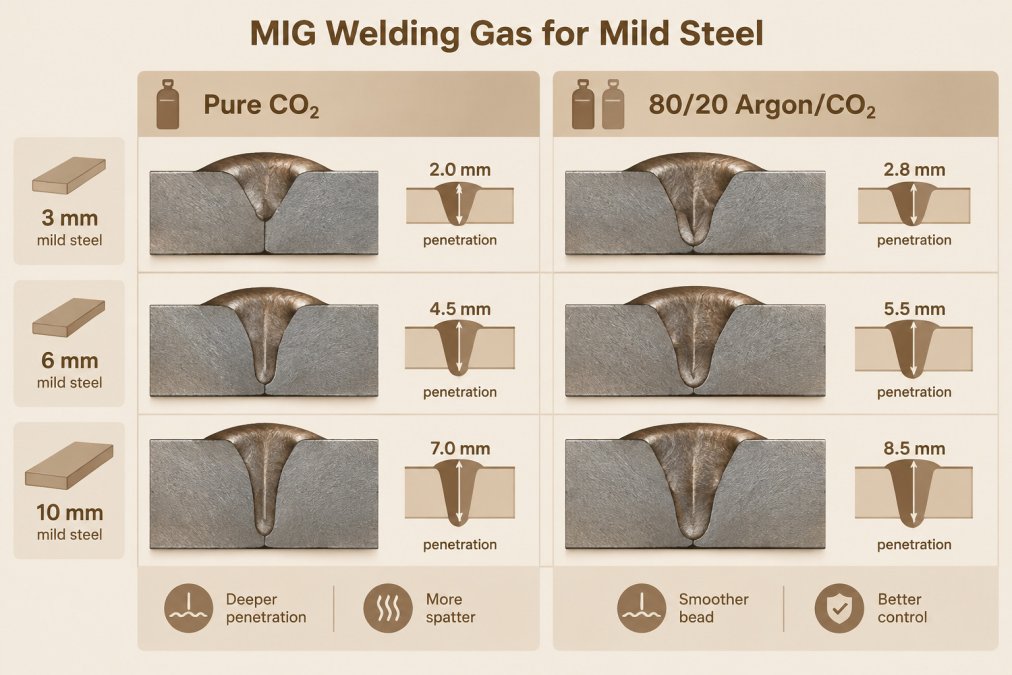
Mild steel is the most common MIG application, and it is where the argon-versus-CO2 decision matters most. The gas changes the physics of the arc: argon’s low thermal conductivity concentrates heat at the wire tip and gives a stable, directional arc, while CO2’s higher thermal conductivity spreads heat into the workpiece and drives deeper fusion. That single difference explains most of the practical trade-offs below.
Matching gas to material thickness
A general starting framework based on common workshop practice:
- Up to about 3 mm sheet: a high-argon blend (around 80-92% argon with CO2 or a CO2/oxygen mix) gives the steadiest short-circuit arc and the least burn-through. Pure CO2 on this thickness runs hot and is harder to control without pulsing or stitching.
- 3-6 mm plate: an 80/20 argon/CO2 blend is the usual all-round choice. It holds penetration on fillet welds while keeping spatter manageable.
- 6-10 mm plate: either a blend run in spray transfer (where the machine and wire support it) or pure CO2 in short-circuit transfer. CO2’s deeper finger-like penetration suits heavier sections where lack of fusion is the main risk.
- Over 10 mm: pure CO2, or a blend with a higher CO2 fraction, is typically chosen for root penetration; preheat and joint preparation matter as much as the gas at this thickness.
Transfer mode changes the answer
The gas and the transfer mode are linked. Short-circuit transfer works with any of the three gas options and is the fallback for thin sheet and out-of-position work. Spray transfer, where the wire forms a fine axial spray of droplets, needs a high argon content (typically 80% or more) and does not run on pure CO2. Globular transfer sits between the two and is generally avoided because it produces large, cold droplets and heavy spatter. If your machine is a basic transformer set without spray capability, the practical choice narrows to short-circuit on a blend or on CO2.
Heat input and distortion
Higher CO2 content raises heat input for a given wire feed speed, which is an advantage on thick plate and a liability on thin sheet. On 1.5-2 mm mild steel, pure CO2 commonly causes distortion, burn-through and a wider heat-affected zone; a high-argon blend lets you run cooler and keep the panel flatter. On thick sections the reverse applies: the extra heat from CO2 helps fusion and reduces the risk of cold lap at the weld toes.
What drives running cost
Gas cost is not the cylinder price alone. It is the combination of gas consumption, refill or rental terms, and the labour spent on cleanup and rework. Pure CO2 is cheaper per litre of gas, but it throws more spatter, so more time goes on grinding, nozzle cleaning and anti-spatter application. A blend costs more per litre but often reduces cleanup enough to offset part of the difference.
Best Gas for MIG Welding Stainless Steel and Aluminium
Stainless steel and aluminium are not suited to pure CO2. CO2 oxidises stainless steel and produces a poor-quality weld, so stainless work normally uses argon-based mixes with a small addition of oxygen or CO2 to stabilise the arc.
Aluminium is welded with pure argon, or with argon-helium mixes where extra heat is needed on thicker sections. Pair the gas with the correct filler wire, such as 4043 or 5356.
MIG Welding Gas Flow Rate, Regulator Settings and Troubleshooting
Flow rate is the variable most often set once and never revisited, yet it is the cause of a large share of gas-related weld faults. A typical starting point is 12-15 litres per minute for indoor work with a standard nozzle, but the correct figure depends on nozzle size, joint type and draught. As a rule of thumb, flow should rise with nozzle diameter and with the openness of the joint; a root gap or an outside corner needs more coverage than a tight fillet.
Starting settings by gas and thickness
The chart below is a starting point, not a prescription, every machine and wire combination differs, so treat it as a baseline to tune from.
| Material thickness | Gas | Transfer mode | Typical flow (L/min) | Starting voltage | Starting wire speed |
|---|---|---|---|---|---|
| 1.5-2 mm | High-argon blend | Short-circuit | 10-12 | Low, per machine chart | Low-mid |
| 3 mm | 80/20 argon/CO2 | Short-circuit | 12-14 | Mid | Mid |
| 6 mm | 80/20 argon/CO2 | Spray (if capable) | 14-16 | High | High |
| 6-10 mm | Pure CO2 | Short-circuit | 14-18 | Mid-high | Mid-high |
| Outdoors, any thickness | Any | Any | Add 2-4 | As above | As above |
Voltage and wire speed are machine-specific, so use the manufacturer’s door chart as the primary reference and the table above to sanity-check the gas and flow side of the setup.
Symptom-to-cause troubleshooting
- Porosity or pitted welds: the usual causes are too little gas, a leak at the regulator or hose, a blocked or spattered nozzle, or draught stripping the shield. Check the gas path from regulator to nozzle before changing settings.
- Excessive spatter: a CO2-rich gas is the most common cause; moving to a blend with more argon reduces it. Also check wire stick-out, too long a stick-out widens the arc and increases spatter.
- Burn-through on thin sheet: lower voltage and wire speed together, increase travel speed, and consider a higher-argon mix. Reducing flow will not fix burn-through and may introduce porosity.
- Turbulence and air entrainment: too much flow creates a Venturi effect that pulls air into the shield, producing porosity that looks like too little gas. If raising flow makes porosity worse, you have found the cause.
- Wandering or unstable arc: check for a worn contact tip, the wrong polarity for the wire, or a gas mix that does not suit the transfer mode, pure CO2 will not sustain spray transfer.
Flow, draught and position
Indoors, run at the lower end of the range and use screens or curtains to break draughts from doors, extractors and open roller shutters. Outdoors, wind strips shielding gas quickly, so raise flow carefully and use windbreaks; simply opening the regulator further without a windbreak wastes gas and still leaves porosity. In out-of-position work, vertical-up, overhead, the shield is more easily disturbed, so a slightly higher flow and a shorter stick-out help.
Starting flow rate by material thickness and gas (L/min)
Gas Consumption, Running Cost and Indoor Versus Outdoor Use
Gas consumption depends on flow rate, duty cycle and how often you stop to change wire. Keeping a log of cylinder changes for a few weeks gives a realistic running cost for your own work. Remember that CO2 is cheaper per cylinder but may need more cleanup, which adds labour.
Indoors, use gas at the lower end of the flow range and shield the arc from draughts. Ensure proper ventilation in every case, as welding fumes are a health hazard (Controlling the risks from welding). For the wider safety picture, the HSE’s welding guidance is the authoritative reference: HSE welding fume and ventilation guidance.
Choosing the Right Shielding Gas for Your Next Job
Start with the material and thickness. Thin stainless and aluminium need argon-based gas. Thick mild steel suits pure CO2 or a blend. Then consider the transfer mode and welding position: short-circuit transfer on thin material generally favours argon-rich mixes, while spray transfer on thicker plate works well with higher argon content.
Finally, weigh the cost of gas against the cost of cleanup and rework. A slightly more expensive blend often wins on total cost. If you are unsure which gas suits your job, get in touch with the Norsemen Safety team before you order.
Frequently Asked Questions
Can you use pure argon for MIG welding mild steel?
Pure argon can be used for MIG welding some non-ferrous metals such as aluminium, but it is generally not suited to mild steel. On mild steel, pure argon tends to produce an unstable arc and a poor, convex bead profile with lack of fusion at the edges. For mild steel, most fabricators choose argon/CO2 blends or pure CO2, depending on whether they prioritise arc smoothness or running cost. Check the gas specification for your wire and material before you buy, and consult Norsemen Safety for guidance on the right gas for your application.
Is CO2 or an argon mix better for MIG welding?
It depends on the job. Pure CO2 gives deeper penetration and is usually cheaper per cylinder, but it produces a harsher arc and more spatter. Argon/CO2 mixes give a smoother, more controllable arc, a cleaner weld bead and less spatter, at a higher gas cost. For thin material, out-of-position work or where cleanup time matters, an argon mix is often preferred. For thicker sections where penetration and running cost matter most, pure CO2 is a practical choice. Pricing depends on quantity and delivery, so request a current quote from Norsemen Safety.
What is the difference between pure CO2 and argon/CO2 shielding gas?
Pure CO2 is a reactive gas that transfers heat strongly into the weld pool, giving deep penetration but a more turbulent arc and more spatter. Argon/CO2 blends add argon to stabilise the arc, which reduces spatter and improves bead appearance and ease of control. Blends are common for mild steel in short-circuit and spray transfer. The best ratio depends on material thickness, transfer mode and the weld quality you need, so test on offcuts before committing to a bulk order.
Which gas gives less spatter when MIG welding?
Argon-rich mixes give the least spatter on mild steel. Adding argon to CO2 stabilises the arc and reduces the violent droplet transfer that causes spatter. Pure CO2 generates the most spatter but is often the lower-cost option. Correct voltage and wire speed settings also reduce spatter regardless of gas, so set those up properly before comparing gases.