
Last Updated: November 24, 2026
Quick Summary
The best welding screens for a narrow workshop bay are usually portable framed, folding or retractable curtain types, chosen by measuring usable width, ceiling height and walkway clearance first. Fixed screens suit dedicated stations, while retractable curtains save the most floor space.
- Measure usable width at floor, waist and head height before shortlisting any screen.
- Allow 100-150 mm of overlap where panels meet to stop light and spatter leaking.
- Retractable curtains take almost no floor space but seal less tightly than rigid screens.
- Portable framed screens need a base depth of about 400-600 mm to stay stable.
- Inspect screens before each use and replace damaged material rather than patching it.
Table of Contents
- Why Narrow Workshop Bays Need a Different Kind of Welding Screen
- How to Measure a Narrow Bay for Screen Fitment
- Folding Welding Screens: Strengths and Limits in Tight Spaces
- Retractable Welding Curtains for Space-Saving Installs
- Comparing the Best Welding Screens for Narrow Bays
- Welding Screen Safety Standards, Ventilation and Maintenance
- Choosing the Right Screen for Your Workshop and Ordering from Norsemen Safety
- Frequently Asked Questions
Why Narrow Workshop Bays Need a Different Kind of Welding Screen
Fabricators with tight bays often ask one question first: will a standard screen even fit? A narrow bay, often no wider than a van, changes which screen works, how it is mounted, and how it is stored.
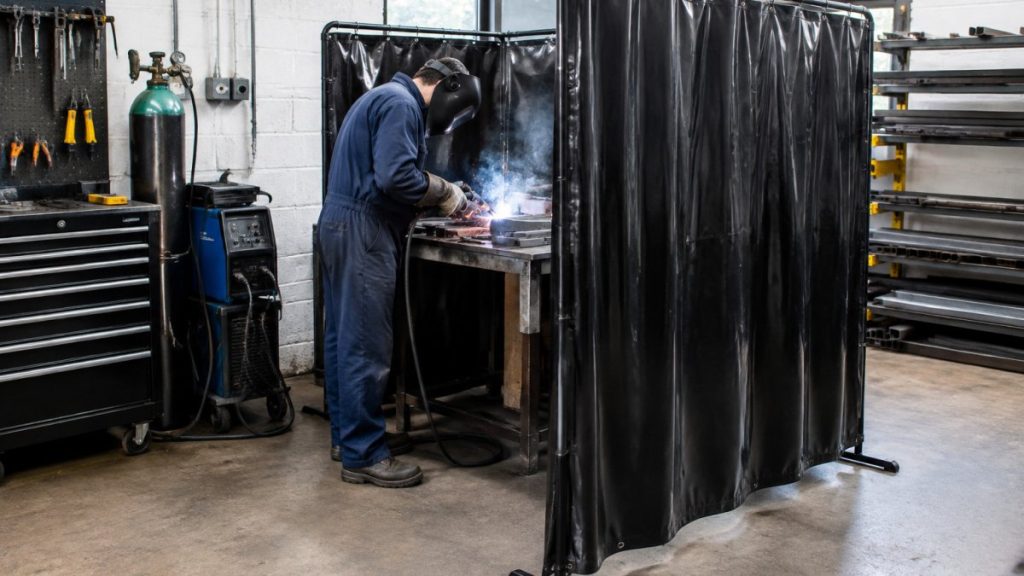
A welding screen shields people nearby from arc flash and UV exposure, and contains sparks and spatter before they reach combustibles or other workers. In a narrow bay, those jobs compete for the same few metres of wall.
The right choice depends on the bay’s geometry, how often it is used, and whether the screen has to move.
How to Measure a Narrow Bay for Screen Fitment
Measure before you shortlist anything. Record the usable width at floor, waist and head height, because pipework, ducting or shelving often narrow the bay higher up.
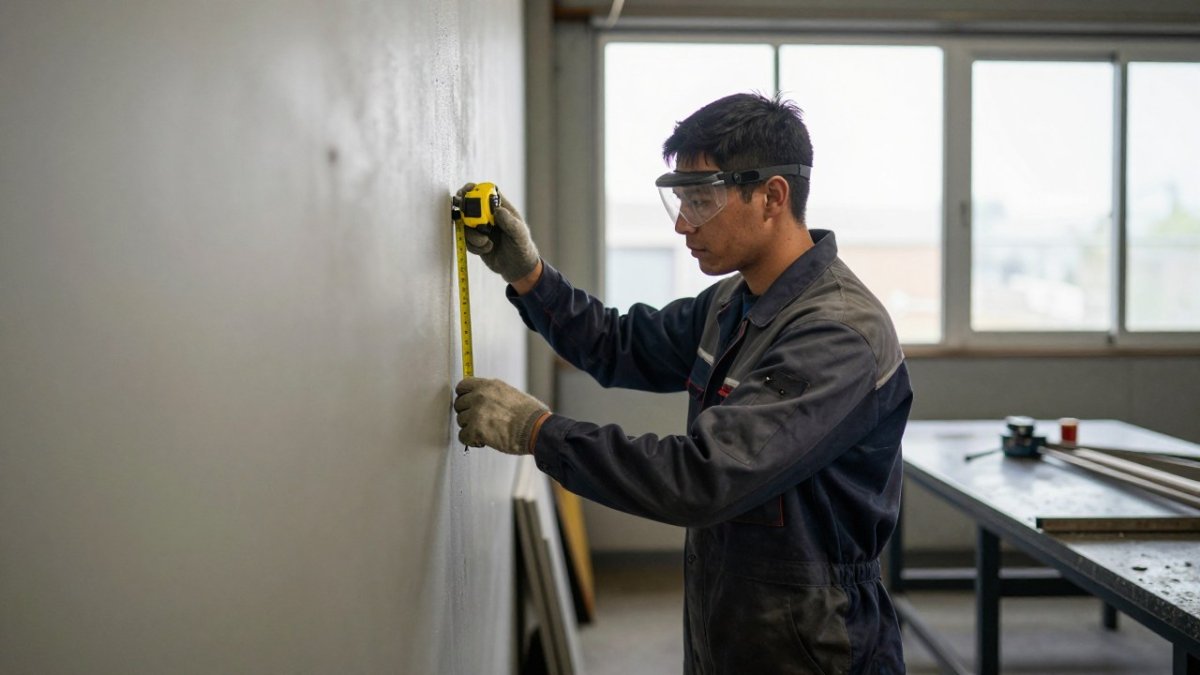
Next, mark the welding zone. Stand where the welder will work and measure how far the arc and spatter could travel in each direction, then add the clearance the screen needs for mounting brackets or for a portable unit’s frame to stand without tipping.
A simple checklist helps:
- Usable width at floor, waist and head height
- Clear ceiling height above the welding position
- Distance from welder to the nearest walkway or bench
- Position of doors, fire exits and extraction points
- Whether the screen must fold or retract to clear the route
Record these figures in millimetres, compare them against the screen’s stated dimensions, and leave a margin so the screen opens and closes without catching on fittings.
Folding Welding Screens: Strengths and Limits in Tight Spaces
Folding screens, often called concertina or hinged screens, let you change the footprint of the enclosure. Open them to cover a welding position, then fold them flat against a wall when the bay is free.
The limits are equally clear. Each hinged panel adds a seam where light and sparks can leak through, and folding screens need a stable base and room at the fold line.
For a practical rule, choose folding screens when the bay is used for several different tasks and the screen must step aside regularly. Avoid them where a single fixed welding station needs an airtight enclosure.
Retractable Welding Curtains for Space-Saving Installs
Retractable curtains mount to a ceiling or wall track and roll up into a housing when not in use.
A common mistake is choosing a curtain without checking the mounting surface.
Retractable curtains do not seal as tightly as rigid screens, so they suit positions where the main goal is spark containment and moderate arc protection. For the highest level of enclosure, pair the curtain with a fixed screen on the exposed side.
Comparing the Best Welding Screens for Narrow Bays
In a narrow bay, the deciding factors are usable width, stand-off from the welding position, folded or retracted storage depth, and how easily the screen can be repositioned without blocking a route.
Selection criteria for a narrow bay
Score each candidate against these five measures before shortlisting:
- Usable coverage width, the open width of the screen, not the panel count. Allow 100-150 mm of overlap where panels meet so light and spatter cannot leak through the seam.
- Stand-off footprint, the floor area taken by the base or frame when the screen is deployed. A portable framed screen typically needs a base depth of 400-600 mm to stay stable; a folding screen needs clearance at the fold line.
- Folded or retracted depth, how far the screen projects from the wall or ceiling when stowed. This is the figure that decides whether the bay can be used for other work.
- Stability, whether the screen resists a knock from a workpiece, a trolley or a cable run. Weighted bases and wall fixings matter more in a narrow bay because there is less room to step around a toppled screen.
- Repositioning effort, whether one person can move or deploy the screen in under a minute, and whether that movement crosses a walkway.
How the main options compare
| Screen type | Deployed footprint | Stowed depth | Best for | Main drawback |
|---|---|---|---|---|
| Portable framed screen | Base plus frame, typically 400-600 mm stand-off | Frame and base stored against a wall | Shared bays, mixed tasks | Base eats floor space and can obstruct a route |
| Folding (concertina) screen | Open width plus fold clearance | Low when folded flat | Bays that must be cleared quickly | Hinged seams leak light and spatter |
| Retractable curtain | Minimal floor footprint | Housing at ceiling or wall track | Narrow bays short on floor space | Less sealed enclosure than rigid screens |
| Fixed screen | Permanent panel footprint | None, always deployed | Dedicated welding stations | Cannot be moved or stowed |
Portable framed screens
A framed screen with a low-profile base is the most flexible option for a bay that serves several tasks. It can be wheeled or lifted into position and needs no fixing point.
Watch out: a portable screen that is stable on open floor can become unstable when its base is pushed against a wall or bench, because the frame has no room to flex. Check that the base sits fully on the floor with no overhang before relying on it.
Folding screens
Folding screens suit bays where the welding position changes or where the screen must step aside for other work. The folded depth is usually small enough to store against a wall. The limitation is the seams: each hinge is a line where arc light can escape and spatter can pass. In a narrow bay the welder is often close to the screen, so seam leakage is more noticeable than in a large booth.
Retractable curtains
Retractable curtains are the strongest option where floor space is the binding constraint. They mount to a ceiling or wall track and roll into a housing, leaving the floor clear. Check the mounting surface, the track weight rating and the drop height: a curtain that is too short leaves a gap at floor level where spatter can travel, and one that is too long drags on the floor and wears.
Fixed screens
A fixed screen is the simplest and most robust option for a dedicated welding station. It does not move, so it does not need storage depth or a base footprint beyond its own panel. The drawback is inflexibility: if the bay layout changes, the screen must be unbolted and refixed. Fixed screens also need a wall or frame strong enough to carry the panel and any mounting brackets.
Matching the option to the bay
Use the measurements from the earlier section to rule options in or out. If the usable width at waist height is less than the open width of the screen plus 150 mm of overlap, the screen will not fit without fouling. If the folded or retracted depth exceeds the clearance between the welding position and the walkway, the stowed screen will still obstruct the route. If the base stand-off leaves less than 800 mm of walkway, a portable framed screen is the wrong choice.
Compare each option against those figures, not against the product photos alone.
Welding Screen Safety Standards, Ventilation and Maintenance
A welding screen is only as good as its condition and its fit. In a narrow bay, where the welder is close to the screen and the air volume is small, condition and ventilation matter more than in an open workshop.
Checking product documentation
Ask the supplier for the product data sheet and confirm the material specification and the stated flame resistance and UV-blocking information. Keep the documentation with the equipment so it can be produced during a risk assessment review or an inspection.
For workplace health and safety in the UK, the Health and Safety Executive publishes guidance on welding fumes and on controlling exposure (Controlling the risks from welding). Use that guidance as the reference point for your risk assessment.
Inspection and maintenance
Inspect the screen before each use and formally at least once a month in frequent-use bays. Look for:
- Tears, holes and thin spots in the curtain or panel material
- Scorched or discoloured areas that suggest heat damage
- Coating damage on coated glass fibre or PVC, which can reduce both flame resistance and UV blocking
- Warped, bent or corroded frames and hinges
- Worn fixings, castors and track runners on retractable systems
- Contamination from oil, dust or spatter that can make the material flammable
Damaged material loses its flame resistance and its ability to block UV, so replace it rather than patching it. Clean screens with a method recommended by the manufacturer; aggressive solvents can degrade coatings.
Watch out: a screen that looks intact can still have a compromised coating on the side facing the arc. Check both faces, and pay particular attention to the area at welder height where spatter lands most often.
Ventilation and fume extraction
A screen contains arc light and spatter, but it does not remove fumes. Position local exhaust ventilation (LEV) so the hood or nozzle draws fumes away from the welder’s breathing zone and the walkway, and check that the screen does not sit between the arc and the extraction point (Controlling the risks from welding).
If the bay relies on general ventilation rather than LEV, confirm that air can still move through or around the screen. A fully sealed enclosure in a small bay without extraction is worse than a partially open screen with good airflow. Review the ventilation arrangement whenever the screen position or bay layout changes.
Reviewing the risk assessment
Review the risk assessment whenever the bay layout, the welding process or the screen changes. Record the screen’s dimensions, material, fixing method and inspection dates. In a narrow bay, small changes, a new bench, a relocated extraction point, a different screen, can alter whether the arrangement is safe.
Choosing the Right Screen for Your Workshop and Ordering from Norsemen Safety
Start with your measurements: usable width, ceiling height, welding position and the route people take past it. Then decide how often the screen must move.
Then narrow the list by material and protection. Confirm flame resistance, UV protection and the material type. Check that the dimensions fit your bay with margin for opening, closing and mounting.
Norsemen Safety offers a range of welding equipment and personal protective equipment for UK workshops. Pricing depends on the product type, size and quantity, so please check the website or request a quote for current prices and delivery options.
Frequently Asked Questions
What type of welding screen is best for a narrow workshop bay?
For a narrow bay, a folding or retractable screen usually works better than a fixed partition, because it can be stowed when not in use and does not block the walkway. Measure the usable width and height first, then match the screen to the spot where the welding will happen. Pricing depends on size, material and quantity, so check the Norsemen Safety website or request a quote for current figures before deciding.
Are folding welding screens suitable for small workshops?
Yes, folding welding screens suit small workshops because they can be opened for a job and folded flat afterwards. Check that the folded footprint and the open span both fit your bay, and allow room to swing the frame without hitting machinery or other people. Look for a stable base so the screen stays upright in a draught.
Can retractable welding curtains save space in a workshop?
Retractable curtains mount to a wall or ceiling and roll away when not needed, so they take up very little floor space. They suit bays where the welding zone must be enclosed only part of the day. Confirm the mounting surface can take the load and that the curtain drops fully to the floor to contain sparks.
Do welding screens need to meet a safety standard?
Welding screens should be made from flame-resistant material and should protect nearby workers from arc flash and spatter. Check the product documentation for compliance with the relevant British standards and make sure your use meets HSE guidance on welding controls in the workplace.