

Last Updated: November 22, 2026
Quick Summary
An arco safetysupplies comparison works best when you score each supplier on the items you actually buy, not headline prices. Build an identical basket from six months of orders, then add delivery, minimum-order charges and the cost of failures such as late or wrong items.
- Build an identical basket from your last six months of orders for each supplier.
- Compare total cost, including delivery to your postcode, surcharges and failure cost.
- Confirm dispatch cut-off and carrier for your postcode before relying on a next-day promise.
- Ask for the declaration of conformity for the exact product, size and batch you intend to buy.
- Order a small trial basket to test real delivery time, packaging condition and picking accuracy.
Table of Contents
- Why Buyers Compare Arco and SafetySupplies
- How We Set Up This Arco Versus SafetySupplies Comparison
- Product Range and Welding PPE Suppliers Compared
- Welding Equipment Suppliers and Consumables Side by Side
- Pricing, Delivery and Returns: Like-for-Like Total Cost
- Standards, Certification and Industrial Safety Supplies Compliance
- How to Choose a Welding Supplier for Your Own Operation
- Frequently Asked Questions
Why Buyers Compare Arco and SafetySupplies
When a welding contractor or site manager goes looking for welding PPE and consumables, the shortlist often includes two names: Arco and SafetySupplies. Buyers weighing up an arco safetysupplies comparison usually want to know which one fits their work, their budget and their delivery needs. Norsemen Safety, a UK and Ireland supplier of welding equipment and personal protective equipment (PPE), publishes this guide to help you run that comparison fairly. For another worked example of how local direct suppliers are compared, read our Rapid Welding vs Welding Supplies Direct: UK comparison.
Most buyers compare on price alone, which is the wrong place to start. A cheaper glove or consumable pack only saves money if it meets the right standard and arrives when you need it. Start with what your job actually requires, then compare range, delivery, returns and support.
Our approach here is to cover the criteria that matter in practice. Each section below takes one of them and explains what to check.
How We Set Up This Arco Versus SafetySupplies Comparison
A fair comparison needs fixed criteria. We have set them out so you can repeat the exercise yourself, using your own order history and your own shortlist. The criteria are product range, welding PPE and consumables coverage, delivery and stock availability, returns handling, pricing on a like-for-like basis, and the standards each product must meet.
Be careful with published prices and stock claims. These change often, so check current figures on each supplier’s site before you place an order. Where we describe a supplier’s offer, we are describing what buyers should look for, not guaranteeing what any one supplier currently provides.
Keep a simple scorecard as you go, so your arco safetysupplies comparison stays consistent. Give each criterion a mark out of five, weight it by how much it matters to your work, and total the result. A site manager buying bulk PPE will weight delivery and certification heavily. A one-person fabrication shop may weight account service and small-quantity ordering more.
Product Range and Welding PPE Suppliers Compared
Range is the first thing to check. A supplier that covers welding helmets, gloves, respirators and consumables in one place saves you from managing several accounts. Look at whether each supplier stocks the specific items on your regular order list, not just the headline categories.
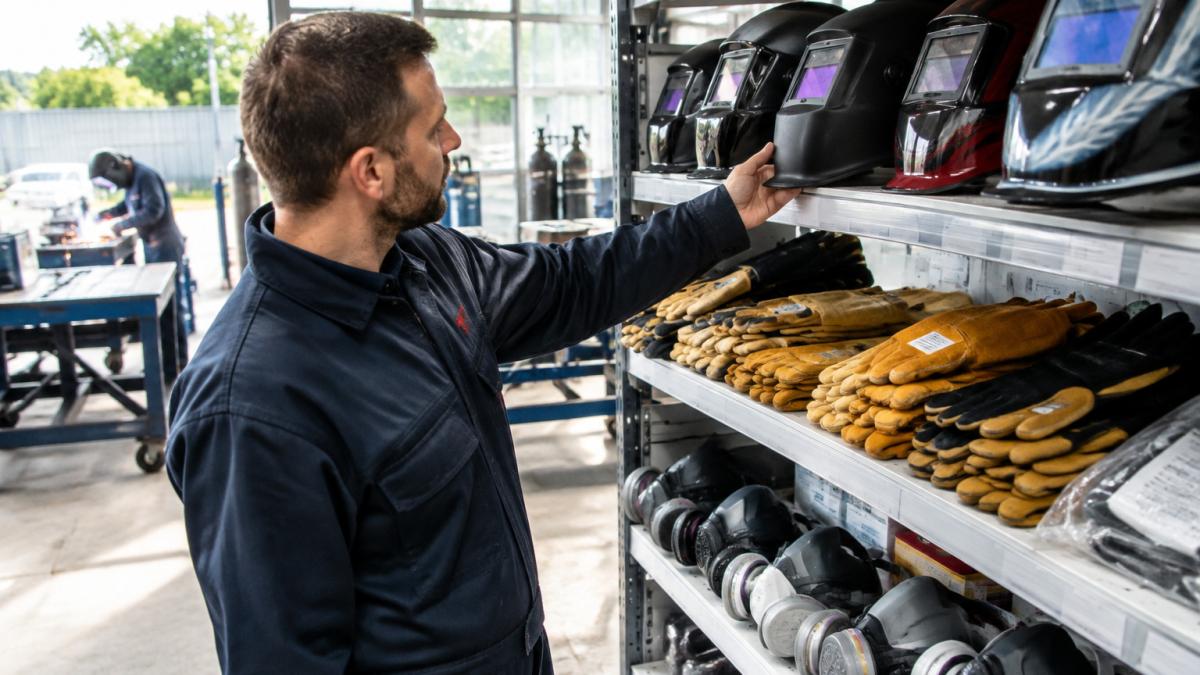
Welding PPE suppliers differ in depth as well as breadth. Check the sizes available for gloves and the filter options for respirators, because a gap in either can hold up a whole crew. Norsemen Safety carries a broad welding PPE range, including respiratory protection, the wider safety equipment range and welding gloves, so you can compare the full set of items you need in one order.
Ask each supplier for its product catalogue and check it against your last six months of orders. Any item you buy regularly and cannot find is a real cost, even if the price looks good.
Welding Equipment Suppliers and Consumables Side by Side
Welding equipment suppliers are often judged on machines, but for most workshops the consumables decide day-to-day cost and downtime. Electrodes, wire, gas and tips are bought again and again, so check the packaging sizes, the minimum order quantities and whether the consumables you use are stocked in the sizes you need.
Compare suppliers on the consumables you actually use, not on a single showcase product. A supplier that stocks your electrode type and diameter in bulk will usually serve you better than one with a wider but thinner catalogue.
Industrial safety supplies follow the same logic. If your site needs eye protection, hearing protection and high-visibility workwear, confirm that all three are available from the same source before you commit to an account.
Pricing, Delivery and Returns: Like-for-Like Total Cost
Pricing is where comparisons most often go wrong. The fair test is the total cost of a realistic order, not the unit price on a product page. Build an identical basket for each supplier using your last six months of orders, then add every cost that sits outside the product price: delivery charges, any minimum order fee, small-order surcharges, pallet or hazardous-goods handling, and the cost of replacing an item that arrives damaged or to the wrong specification.
Published prices and quote-based prices are different things. Some lines carry a visible price on the product page; others, particularly bulk consumables and account orders, are quoted. When you compare, keep the two separate. A published price is only comparable to another published price for the same pack size, standard and quantity. A quote is only comparable to another quote built on the same basket, the same delivery postcode and the same requested lead time.
A practical method is to score each supplier on four cost lines:
- Product cost: the same items, same pack sizes, same standards, same quantities.
- Delivery cost: the charge for your actual postcode, including remote and offshore areas, and whether it changes with order value or weight.
- Minimum order and surcharges: any minimum spend, small-order fee or handling charge that applies to your typical order.
- Failure cost: the cost to your operation if an item is late, wrong or damaged, including replacement lead time and any downtime.
Delivery and returns deserve the same discipline. Ask each supplier:
- What is the typical delivery time to your site, including remote areas in Scotland, Northern Ireland and offshore locations?
- What is the dispatch cut-off, and which carrier handles your postcode?
- What happens if an order arrives damaged or incorrect, and how quickly is a replacement dispatched?
- Is there a returns window, who pays return postage, and are special-order or consumable items excluded?
Watch out: a supplier’s quoted delivery time is not the same as your delivery time. Confirm the dispatch cut-off and the carrier for your postcode before you rely on a next-day promise, and check whether the promise covers the whole order or only items held in stock.
Stock availability is part of cost too. An item shown as available but dispatched from a remote warehouse can add days. Ask whether the stock figure is held locally or centrally, and whether split orders are consolidated or charged separately. For recurring workplace orders, ask about scheduled deliveries and account terms, because a reliable schedule can be worth more than a small unit-price saving.
The table below sets out the four cost lines to score for each supplier, so you can build a like-for-like total.
| Cost line | What to compare | What to check |
|---|---|---|
| Product cost | Same items, pack sizes, standards and quantities | Build an identical basket from six months of orders |
| Delivery cost | Charge for your actual postcode | Include remote and offshore areas |
| Minimum order and surcharges | Minimum spend, small-order fee, handling charge | Apply to your typical order size |
| Failure cost | Cost if an item is late, wrong or damaged | Replacement lead time and any downtime |
Standards, Certification and Industrial Safety Supplies Compliance
Standards are the criterion buyers most often leave until last, though for PPE it should come first. PPE placed on the market in the UK must meet the applicable regulatory requirements, and products should carry the appropriate conformity marking together with a declaration of conformity (Using personal protective equipment (PPE) to control risks at work). Check the marking and the documentation for each item, not the supplier’s general claims.
A transparent checklist is the best way to compare suppliers on assurance. For any PPE item you intend to buy in bulk, ask each supplier to confirm:
- Marking: the CE or UKCA mark is on the product or its packaging, and the mark matches the item you are buying.
- Declaration of conformity: a current declaration is available for the exact product and size, not just the product family.
- Standard reference: the relevant British or European standard is stated on the product or data sheet, for example the standard covering welding helmets, gloves or respiratory protection.
- Traceability: the batch or lot number can be linked to the declaration and, where applicable, to test documentation.
- Instructions: manufacturer instructions and warnings are supplied in English and cover the limits of use.
For welding consumables and respiratory protection, look for the relevant British or European standard on the product or its data sheet. Ask each supplier to send the certification for any item you intend to buy in bulk, and keep a copy on file for your own records and audits. A supplier that can produce the declaration quickly and for the exact item is easier to audit than one that sends a generic certificate.
Health and safety regulations set the duties employers must meet when selecting PPE (Using personal protective equipment (PPE) to control risks at work: Overview). Buying compliant products does not replace your own risk assessment, so make sure the PPE you select matches the hazards on your site. Record the standard you selected against each hazard in your assessment, and keep the declaration of conformity with that record.
Watch out: a declaration of conformity for one size or variant does not automatically cover another. Confirm the documentation matches the exact item, size and batch you are buying before you rely on it.
Note: product standards and certification requirements change, so confirm current requirements with the HSE or a qualified safety adviser rather than relying on this article alone.
How to Choose a Welding Supplier for Your Own Operation
The right supplier depends on how you buy. A large procurement team buying bulk safety equipment will weigh account management, invoicing and contract terms. A sole trader needs small-quantity ordering and a quick answer to a question about which electrode to use.
Work through the scorecard from earlier with your own numbers. Score each supplier on range, delivery, returns, total cost and certification, then weight the scores by your priorities. Then test the service. Call each supplier with a real question about a product you use. Note how long it takes to reach someone, and whether that person can give a clear, accurate answer.
Finally, order a small trial basket before moving your whole account. A trial shows you the real delivery time, the packaging condition and the accuracy of the picking. It costs a little now and can save a lot of downtime later.
If you are weighing Norsemen Safety against your current supplier, you can browse the full range and place a trial order to test our delivery, returns and product information against your own criteria.
Frequently Asked Questions
What is the difference between Arco and SafetySupplies?
Both are UK suppliers of safety and industrial products, but they differ in focus, catalogue depth and service model. Each supplier has its own focus, catalogue depth and service model, so compare the specific lines you buy before deciding. Buyers should compare the specific lines they buy, check current stock and delivery terms, and ask each supplier for a quote on the same basket of items before deciding. Pricing depends on quantity, dates and delivery, so confirm current prices directly with each supplier.
Which supplier has a wider range of welding PPE?
Range depends on the exact items you need, such as welding helmets, flame-retardant clothing, gloves and respiratory protection, and on what is in stock when you order. Compare the product pages for your specific requirements, check that each item is marked to the relevant British or European standard, and note which brands are carried. Norsemen Safety offers welding equipment and personal protective equipment, so you can check current availability on the Norsemen Safety website or request a quote for your list.
Can businesses get expert advice from Arco or SafetySupplies?
Both suppliers offer account and customer service support, but the depth of technical advice varies by enquiry and by how you order. Ask in advance who will handle your account, how quickly they respond, and whether they can advise on selecting PPE for a specific task or sector. Norsemen Safety has a dedicated team for product and service support.