
Updated August 2026
Chinese Mig Welding Wire
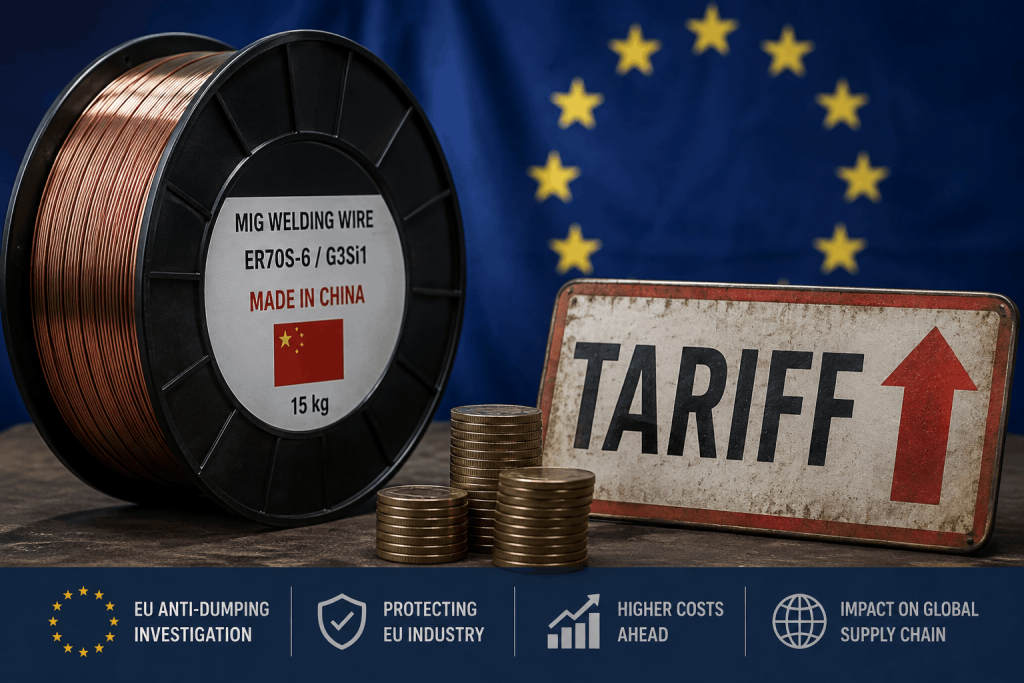
If you buy or use large quantities of MIG welding wire, you may have heard about the European Union’s new anti-dumping investigation into certain welding wires originating in China.
The development could have significant implications for welding consumable prices, particularly for businesses purchasing high volumes of 70S6 / ER70S-6 MIG wire.
But there is an important point that is sometimes missed:
Not all 70S6 welding wire is the same, and the term ER70S-6 alone does not determine whether a particular wire is covered by the EU investigation.
The European Commission’s measure is based on the product’s chemical composition, diameter, coating and country of origin.
For businesses currently purchasing Chinese-origin MIG wire, this is therefore a good time to review their supply chain and consider European alternatives.
One option worth considering is the ELGA ELGAMATIC NEO range, which includes both G3Si1/ER70S-6 and G4Si1/ER70S-6 versions.
How could this affect UK and Northern Ireland welding businesses?
Although the current EU anti-dumping investigation is aimed at Chinese-origin welding wire entering the EU, rather than imports into the UK, UK and Northern Ireland businesses should not assume that they will be unaffected.
The reason is the knock-on effect through the European welding-wire supply chain. If Chinese-origin wire becomes more expensive or more difficult for European wholesalers to source, UK distributors and wholesalers may increasingly turn to European-produced alternatives. European-manufactured welding wire can carry a higher purchase price than the Chinese product it replaces, and those increased costs are likely to work their way through the supply chain — from manufacturer, to wholesaler, to distributor and ultimately to the end user.
This means that even where a particular UK or Northern Ireland business is not directly paying an EU anti-dumping duty on its welding wire, it could still see higher prices for 70S6/ER70S-6 welding wire as the market adjusts.
There is an additional consideration for businesses in the Republic of Ireland purchasing welding wire from suppliers in Great Britain. Where the goods are of Chinese origin and are subsequently imported into the EU, the applicable EU customs and trade-defence measures need to be considered. The fact that the wire was purchased from a UK supplier does not automatically change its country of origin or remove an applicable EU measure.
For Irish businesses, this makes the origin of the welding wire particularly important. A UK distributor selling Chinese-origin wire into Ireland is not necessarily providing the same customs position as a UK distributor supplying European-origin welding wire.
In practical terms, the market could therefore see a situation where Chinese-origin wire becomes subject to additional costs when entering the EU, while European-origin alternatives become increasingly attractive despite having a higher underlying purchase price.
For welding contractors and fabricators, the result could ultimately be higher consumable costs regardless of whether they buy directly from Europe, from a UK wholesaler or from an Irish distributor.
What is happening with Chinese welding wire?
The European Commission has opened an anti-dumping investigation into certain silico-manganese steel welding wires originating in China.
On 9 February 2026, the European Commission adopted Commission Implementing Regulation (EU) 2026/297, making imports of the products concerned subject to registration.
The investigation followed a complaint from European producers of welding wire.
The important point for buyers is that this is not simply an investigation into products labelled “70S6”.
The EU has defined the product concerned according to specific technical characteristics.
That means businesses should not assume that every ER70S-6 wire is either included or excluded simply because of its classification.
Is 70S6 the same as G3Si1?
This is one of the most important points to understand.
ER70S-6 is an AWS classification.
Under the EN ISO 14341-A classification system, ER70S-6 wires can be found as different grades, including G3Si1 and G4Si1.
For example, ESAB lists its Weld G3Si1 product as a G3Si1 / ER70S-6 wire.
ELGA’s current range provides another useful example:
- ELGAMATIC NEO 100 — G3Si1 / ER70S-6
- ELGAMATIC NEO 103 — G4Si1 / ER70S-6
ELGA’s 2026 product handbook confirms both products are classified as AWS A5.18 ER70S-6.
Other major welding manufacturers also list both G3Si1 and G4Si1 products under ER70S-6. Böhler, for example, lists ER70S-6 products corresponding to both 3Si1 and 4Si1 classifications.
Why does this matter?
Because 70S6 is not a unique chemical composition.
Two wires can both legitimately be sold as ER70S-6 while having different EN ISO classifications and different levels of manganese and silicon.
G3Si1 generally has lower manganese and silicon levels than G4Si1.
G4Si1 wires can provide higher weld-metal strength and impact properties.
ELGA specifically states that its NEO 103 G4Si1 wire offers higher strength and impact properties than G3Si1 wire.
Therefore, if you are changing from one manufacturer’s 70S6 wire to another, it is important to compare the complete technical specification, rather than simply matching the words “70S6”.
Which welding wires are covered by the EU measure?
The EU regulation defines the products concerned by their technical characteristics.
The scope includes silico-manganese steel welding wire with:
- Diameter from 0.6 mm to 4 mm
- Carbon content of 0.2% or less
- Silicon content of 0.6% to 1.4%
- Manganese content of 0.9% to 1.9%
- Certain specified alloying-element limits
- Copper coating, bronze coating, wax/oil-based lubricant or no such coating
The products are classified under CN code ex 7229 20 00.
The word “ex” is important.
It means that the measure does not automatically apply to every product that happens to fall under the broader CN heading 7229 20 00.
The product must also meet the technical characteristics specified in the regulation.
Does the investigation cover bronze-coated welding wire?
Yes.
This is another important point for buyers who may have assumed that bronze-coated wire was outside the investigation.
The EU product definition expressly includes welding wire with copper coating or bronze coating, as well as certain other surface conditions.
Therefore, the fact that a welding wire is bronze-coated rather than traditionally copper-coated does not by itself determine whether it falls within the scope of the EU measure.
The same principle applies to the product’s ER70S-6, G3Si1 or G4Si1 classification.
The complete specification and country of origin need to be considered.
Does the EU measure mean there is already an anti-dumping duty on Chinese 70S6?
Not necessarily.
This distinction is important.
The February 2026 regulation introduced registration of the relevant imports while the anti-dumping investigation progresses.
Registration is significant because, depending on the outcome of the investigation, anti-dumping duties may potentially be imposed retrospectively on registered imports.
However, businesses should not describe the current position as though a final anti-dumping duty has already been imposed on every Chinese 70S6 wire.
The investigation is still an evolving situation.
For purchasers, the sensible approach is to monitor developments and consider alternative sources before any potential increase in landed cost affects their supply chain.
Why country of origin is becoming increasingly important
For welding-wire buyers, there are two separate questions:
What is the specification of the wire?
and
Where was the wire manufactured?
A wire can be ER70S-6, G3Si1 or G4Si1 regardless of whether it is produced in China, Italy, Sweden or another country.
The EU measure is concerned with the origin of the product, together with whether the product falls within the defined technical scope.
Consequently, businesses buying welding wire should establish the actual manufacturing origin of the product rather than relying solely on the location of the distributor or supplier.
For larger purchases, it is sensible to retain appropriate manufacturer documentation, technical data and origin documentation.
Is European-made 70S6 welding wire an alternative?
For businesses looking to reduce their reliance on Chinese-origin welding wire, European-produced alternatives are worth investigating.
However, choosing an alternative should not simply mean finding another product with “70S6” printed on the box.
The correct replacement should be selected according to:
- Existing welding procedure
- EN ISO classification
- AWS classification
- Weld-metal chemistry
- Mechanical requirements
- Wire diameter
- Shielding gas
- Welding current
- Application
- Customer or project requirements
- Existing WPS/PQR requirements where applicable
This is particularly important when changing between G3Si1 and G4Si1 products.
ELGA ELGAMATIC NEO – an alternative to Chinese mig welding wire-origin 70S6
One range that is particularly interesting for businesses looking for an alternative is ELGA ELGAMATIC NEO.
Importantly, ELGA offers two NEO grades, which makes it possible to select the appropriate wire according to the specification currently being used.
ELGAMATIC NEO 100 – G3Si1 / ER70S-6
ELGAMATIC NEO 100 is a bronze-coated mild-steel welding wire classified as:
EN ISO 14341-A: G3Si1
AWS A5.18: ER70S-6
This makes NEO 100 particularly relevant where a customer is currently using a conventional G3Si1 / ER70S-6 / 70S6 wire.
ELGA describes NEO 100 as a premium bronze-coated manganese-silicon wire designed for welding with CO2 or Ar/CO2 shielding gases.
ELGAMATIC NEO 103 – G4Si1 / ER70S-6
ELGAMATIC NEO 103 is also classified as:
AWS A5.18: ER70S-6
but under EN ISO 14341-A it is:
G4Si1
ELGA describes NEO 103 as a premium bronze-coated G4Si1 wire designed for CO2 and Ar/CO2 shielding gases.
ELGA’s current technical data gives NEO 103 a typical weld-metal chemistry of approximately:
- Carbon: 0.07%
- Silicon: 0.90%
- Manganese: 1.65%
with a specified maximum manganese content of 1.85%.
The product is available in 1.0 mm and 1.2 mm diameters according to ELGA’s current technical datasheet.
What are the advantages of ELGA NEO?
The NEO range uses a bronze coating, rather than the traditional copper coating found on many conventional MIG wires.
ELGA describes the bronze coating as providing:
- Excellent arc stability
- Smooth bead appearance
- Consistent welding quality
- Good performance under demanding conditions
- Suitability for mechanised and robotic welding
NEO 103 is specifically positioned for applications including structural steel fabrication, transportation, heavy equipment, agricultural machinery and earth-moving equipment.
For high-volume fabrication businesses, the consistency of the wire can be particularly important.
A welding wire should not simply be judged on its price per kilogram.
Wire feeding, contact-tip performance, spatter, arc stability, rework and production downtime can all affect the actual cost of welding.
Bronze-coated versus copper-coated MIG wire
Traditional MIG welding wire is commonly copper-coated.
Bronze-coated wire takes a different approach.
The purpose is not simply cosmetic. The surface treatment is engineered to provide the electrical and feeding characteristics required for reliable MIG/MAG welding while offering a different surface technology.
ELGA’s NEO range is specifically designed around this bronze-coated construction.
For companies currently using copper-coated Chinese mig welding wire 70S6 wire, moving to a bronze-coated European wire can therefore represent more than simply changing supplier.
The welding application should be assessed to ensure that the new consumable is appropriate.
Can you simply replace Chinese 70S6 with ELGA NEO?
Not in every application without checking.
This is where technical advice is important.
If the existing wire is:
G3Si1 / ER70S-6
then ELGAMATIC NEO 100 is the more directly comparable NEO option.
If the existing wire is:
G4Si1 / ER70S-6
then ELGAMATIC NEO 103 is the corresponding NEO grade.
Both are ER70S-6 products, but they are not the same EN ISO classification.
Where a welding procedure specification, customer approval or specific mechanical-property requirement is involved, the change should be reviewed appropriately before production.
What should businesses buying MIG wire do now?
If your company currently purchases Chinese mig welding wire -origin 70S6 welding wire, there is no reason to panic — but there is a good reason to review your supply chain.
1. Check where your wire is actually manufactured
Ask your supplier for the actual country of manufacture.
Do not assume that a European distributor means the wire is European-origin.
2. Check the complete classification
Look beyond “70S6”.
Establish whether your current wire is:
G3Si1 / ER70S-6
or
G4Si1 / ER70S-6
3. Check the technical data
Compare:
- Chemical composition
- EN ISO classification
- AWS classification
- Mechanical properties
- Wire diameter
- Surface coating
- Shielding gas requirements
4. Check your customs classification
The EU regulation references ex CN 7229 20 00.
However, the commodity code alone does not determine whether a particular product is covered. The technical definition in the regulation must also be considered.
5. Consider an alternative source
If your business depends heavily on Chinese mig welding wire -origin wire, investigate alternative manufacturers now.
Changing supplier before a potential change in import costs gives you time to:
- Test the wire
- Compare welding performance
- Confirm approvals
- Update purchasing specifications
- Establish pricing
- Avoid a last-minute supply-chain change
What does this mean for UK and Irish welding companies?
The situation can be particularly relevant for companies supplying welding consumables across the UK, Northern Ireland and Ireland.
The EU anti-dumping investigation concerns specified products originating in China and imported into the EU.
The customs treatment of a particular shipment can depend on its origin, route, destination and the applicable customs arrangements.
Businesses should therefore avoid assuming that a rule applying to a Chinese-origin import into the EU automatically applies in exactly the same way to every movement of welding wire between Great Britain, Northern Ireland and Ireland.
For significant commercial shipments, the correct customs treatment should be confirmed for the specific transaction.
The future of 70S6 welding wire
The EU investigation is a development that welding consumable buyers should keep watching.
For companies that have built their purchasing strategy around low-cost Chinese mig welding wire -origin 70S6 wire, the potential impact goes beyond the price of a single 15 kg spool.
It can affect:
- Manufacturing costs
- Tender pricing
- Contract margins
- Stockholding
- Supply security
- Customer pricing
- Production planning
For this reason, now is a good time to understand exactly what you are buying.
70S6 is not a complete product specification.
A welding wire may be G3Si1 / ER70S-6 or G4Si1 / ER70S-6, and the correct alternative needs to be selected accordingly.
Looking for an alternative to Chinese 70S6 welding wire?
At Norsemen Safety & Welding, we can help you identify a suitable alternative based on the wire you currently use.
The ELGA ELGAMATIC NEO range provides both:
ELGAMATIC NEO 100 — G3Si1 / ER70S-6
and
ELGAMATIC NEO 103 — G4Si1 / ER70S-6
allowing the replacement to be selected according to the existing wire specification.
If you currently buy Chinese mig welding wire -origin 70S6 wire and want to investigate an alternative, contact Norsemen Safety & Welding to discuss your current specification and the most appropriate ELGA NEO option.
Important note
This article provides general information about the EU’s 2026 anti-dumping investigation and welding-wire classifications. The investigation and applicable customs measures may change. The inclusion of a product within the EU measure depends on the specific product characteristics and origin. Businesses should obtain appropriate customs and technical advice before making import or purchasing decisions.
Sources: European Commission / EUR-Lex, Commission Implementing Regulation (EU) 2026/297; ELGA Welding 2026 technical documentation; manufacturer technical classifications from ELGA, ESAB and Böhler/voestalpine.