
Table of Contents
- Why Reliable Welding Consumables Delivery Matters
- Understanding Welding Wire Delivery Times and Planning Ahead
- MIG Contact Tip vs Welding Nozzle: Which Consumables You’ll Need
- Welding Consumable Storage Standards to Protect Your Inventory
- What to Expect When Ordering Welding Consumables
- Reducing Downtime Through Smart Ordering and Stock Management
- Frequently Asked Questions
Last Updated: October 7, 2026
Why Reliable Welding Consumables Delivery Matters
Getting welding consumables delivered on time isn’t a convenience, it’s the difference between a productive site and an expensive standstill. When your team needs fresh wire, electrodes, or contact tips and they’re not there, projects slip, deadlines crack, and costs spiral. Norsemen Safety understands this pressure because we work with fabrication shops, maintenance engineers, and construction teams across the UK and Ireland who depend on consistent supply chains to keep operations running.
Welding consumables delivery underpins every successful welding operation. Whether you’re managing a small independent workshop or coordinating multiple sites across remote areas, your supply chain has to be reliable. Poor delivery performance compounds quickly: a missed shipment becomes a delayed project, which becomes lost revenue. The stakes are too high to leave this to chance.
This guide covers what actually matters when ordering welding consumables, planning, storage, inventory management, and how to avoid the pitfalls that cost time and money. We’ll walk through the practical realities of sourcing and managing consumables so your team stays supplied without tying up capital in excess stock.
Understanding Welding Wire Delivery Times and Planning Ahead
Delivery timescales for welding consumables vary significantly based on stock availability, location, and how far ahead you plan. Most UK suppliers can deliver standard wire and electrodes within 2-5 working days for in-stock items. Specialised consumables, rare alloys, specific diameters, or bulk orders, may take 7-10 working days or longer. Remote sites in Scotland or Ireland often face longer lead times, sometimes 7-14 days depending on the supplier’s logistics network.
The real lesson here is that planning ahead transforms delivery from a crisis into a routine. Teams that order consumables reactively, when they’re nearly out, face the worst of both worlds: delayed projects and premium shipping costs. Proactive ordering, by contrast, means you’re working with standard lead times and regular pricing.
Here’s what matters for planning:
- Standard stock items (common wire gauges, general-purpose electrodes) typically arrive fastest because suppliers hold them in regional warehouses
- Bulk orders sometimes qualify for reduced delivery times if they align with scheduled distribution runs
- Remote locations require longer lead windows; ordering 2-3 weeks ahead prevents surprises
- Seasonal demand peaks (spring construction season, autumn maintenance windows) can extend timescales as suppliers manage higher order volumes
The point isn’t to over-order and waste capital; it’s to order frequently enough that you never run dry.
Set a standing order for your baseline consumables. Most suppliers allow you to adjust quantities week-to-week while maintaining predictable delivery slots. This removes the guesswork and keeps cash flow steady.
MIG Contact Tip vs Welding Nozzle: Which Consumables You’ll Need
Understanding the difference between a MIG contact tip and a welding nozzle is essential because they’re often confused, and ordering the wrong one creates downtime. Both are critical consumables, but they serve different functions and wear at different rates.
A MIG contact tip is the small copper electrode that sits inside the torch and makes direct electrical contact with the welding wire. It conducts current to the wire as it feeds through. Contact tips wear quickly because they’re exposed to heat and wire friction; expect to replace them every 8-16 hours of welding, depending on wire type and amperage. A worn contact tip causes erratic arc, poor wire feed, and spatter.
A welding nozzle (also called a gas nozzle or shroud) is the ceramic or metal tube that surrounds the contact tip and directs shielding gas around the weld pool. Nozzles wear more slowly than contact tips, typically lasting 40-80 hours, but they’re equally important. A damaged nozzle redirects gas flow, leading to porosity and weak welds.
The confusion arises because both are small, both live inside the torch head, and both need replacing regularly. But they’re separate parts with different replacement intervals. A typical MIG torch setup includes one contact tip and one nozzle, and you should stock multiples of each.
When ordering consumables for MIG work, plan for this replacement schedule:
- Contact tips: order 2-3 per week of active welding (more for high-amperage work)
- Nozzles: order 1-2 per month
- Liners: order as needed (typically every 2-3 months, depending on wire type)
Different wire types and diameters require different contact tip sizes. Stainless steel wire uses different tips than mild steel; 0.8mm wire needs different tips than 1.0mm. Ordering the wrong size creates immediate problems. Norsemen Safety stocks many contact tips and nozzles across common specifications, and our dedicated team can help you identify the exact parts your equipment needs.
A common mistake is buying generic “MIG consumables kits” without checking the torch model and wire specifications. Generic kits often include parts that don’t fit your equipment or wire type. Always verify the torch model and wire diameter before ordering, a 10-minute check prevents wasted money and downtime.
Welding Consumable Storage Standards to Protect Your Inventory
How you store welding consumables directly affects their performance and lifespan. Poor storage conditions degrade wire, electrodes, and nozzles, leading to weak welds and unpredictable results. Storage standards exist for good reason: they protect your investment and ensure consistent weld quality.
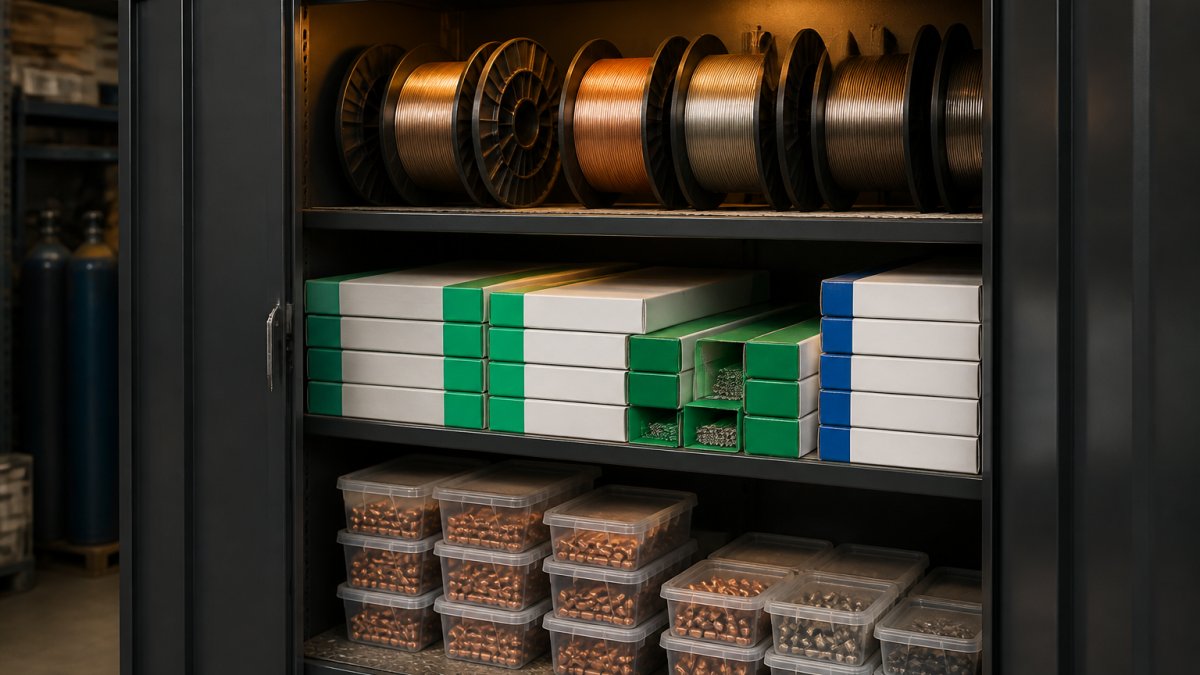
Wire storage is the most critical. Welding wire absorbs moisture from humid air, which causes porosity in the weld. Store wire in sealed containers in a dry environment, ideally below 65% relative humidity. Temperature should remain stable; fluctuating temperatures cause condensation inside storage containers. If your workshop doesn’t have climate control, invest in sealed storage cabinets with desiccant packs. Replace desiccant packs monthly in damp climates.
Electrodes and flux-cored wire are even more moisture-sensitive than solid wire. Many fabricators store electrodes in heated storage ovens (called rod ovens) that maintain temperature at 50-90°C, keeping moisture out. This is industry standard for stick electrodes and low-hydrogen types. If you’re not using a rod oven, store electrodes in sealed containers with desiccant and keep them in the warmest, driest part of your workshop.
Contact tips and nozzles should be stored in sealed bags or containers, away from dust and moisture. Copper oxidises in damp conditions, affecting electrical conductivity. A simple sealed plastic box with silica gel packets works well.
Gas cylinders need secure, upright storage away from heat sources and direct sunlight. Acetylene cylinders must remain upright; propane cylinders can be horizontal or upright. Store cylinders away from reactive materials and electrical equipment.
The cost of proper storage, sealed containers, desiccant packs, temperature control, is trivial compared to the cost of rejected welds or scrapped parts. Many teams discover this the hard way after a humid summer ruins a batch of wire.
What to Expect When Ordering Welding Consumables
Ordering consumables should be straightforward, but confusion around specifications, lead times, and delivery options often creates friction. Understanding what to expect removes surprises and helps you plan accurately.
When you place an order, the supplier needs specific information to fulfil it correctly. For wire, you’ll specify alloy type (mild steel, stainless, aluminium), diameter (0.8mm, 1.0mm, 1.2mm), spool size, and shielding gas type (CO₂, argon mix, or none for flux-cored). For electrodes, you’ll specify type (6013, 7018, low-hydrogen), diameter, and quantity. For MIG consumables, torch model and wire diameter. Vague orders lead to wrong shipments; specific orders arrive right first time.
Delivery options vary by supplier and order size. Standard delivery typically means 2-5 working days to most UK postcodes and up to 7-10 days for Ireland or remote Scottish locations. Expedited delivery (next working day or 2-day) is usually available at a premium. Bulk orders sometimes qualify for free delivery; small orders may incur a charge. Ask your supplier about their thresholds.
Most suppliers offer flexible payment options. Buy Now, Pay Later schemes through providers like PayPal allow you to manage cash flow without delaying orders. This is especially useful for smaller operations or when unexpected consumable needs arise mid-project.
Returns and replacements matter. If consumables arrive damaged or incorrect, a good supplier processes replacements quickly, ideally within 1-2 working days. Ask about the returns process before you order so you know what to do if something goes wrong. Damage during transit isn’t your fault, and you shouldn’t absorb the cost or downtime.
Before ordering, create a simple specification sheet for each consumable type your team uses: wire alloy and diameter, electrode type, MIG torch model, shielding gas. Keep it visible in your workshop. New team members reference it, orders go out faster, and mistakes drop dramatically.
Reducing Downtime Through Smart Ordering and Stock Management
The most effective way to reduce downtime is to stop treating consumables as emergency purchases and start treating them as predictable inventory. This shift, from reactive to planned ordering, transforms your supply chain from a source of stress into a reliable system.
Start by tracking consumption. For one month, record how much wire, how many electrodes, and how many contact tips your team actually uses. Note the alloy types, diameters, and specifications. This data becomes your baseline. A fabrication shop might discover it uses 8kg of 1.0mm mild steel wire weekly and 200 contact tips monthly. A maintenance team might use 2kg of wire and 40 contact tips. Once you know your baseline, you can order predictably.
Build a buffer into your ordering. If you use 8kg of wire per week, order for 10 days (roughly 11-12kg) rather than exactly 8kg. This buffer absorbs unexpected demand spikes and supplier delays without forcing you into emergency orders. The extra inventory costs less than expedited delivery or project delays.
Establish a supplier relationship. A good supplier, one that understands your specifications, delivery location, and typical order patterns, can help you optimise your ordering. They might alert you to price changes, suggest bulk-buy opportunities, or flag lead-time issues before they affect your project.
Use a simple inventory system. You don’t need software; a spreadsheet tracking what you have, what you’ve ordered, and when it arrives prevents double-ordering and stock-outs. Update it weekly. Teams that do this see 30-40% fewer supply interruptions compared to teams managing inventory informally.
Consider consolidating suppliers. Working with one trusted supplier for most consumables (wire, electrodes, contact tips, nozzles, PPE) simplifies ordering, improves delivery consistency, and often qualifies you for better pricing. It also means one point of contact when problems arise, no chasing multiple suppliers when something goes wrong.
Getting welding consumables delivered reliably isn’t about finding the cheapest option or the fastest shipping. It’s about building a supply system that matches your actual consumption, keeps your team supplied without waste, and minimises the friction between order and delivery. Norsemen Safety has over 40 years of industry expertise. We stock a comprehensive range of welding wire, electrodes, contact tips, nozzles, and related consumables, with delivery options tailored to your location and schedule.
Frequently Asked Questions
How quickly can I get welding consumables delivered if I’m ordering urgently?
Delivery speed depends on your location, stock availability, and the supplier’s logistics network. Standard delivery across the UK and Ireland typically takes 2-5 working days, though some suppliers offer next-working-day options for orders placed before a set time. Remote sites in Scotland or rural Ireland may require longer lead times. Check with your supplier about their express delivery options and any additional charges that apply.
What’s the difference between a MIG contact tip and a welding nozzle, and do I need both?
A MIG contact tip is the small consumable that transfers electrical current to the welding wire, while a welding nozzle (or shroud) directs shielding gas around the arc. Both are essential parts of MIG welding equipment, though they wear at different rates. Contact tips typically need replacing after 8-10 hours of use, while nozzles last longer. Order both regularly to avoid production stalls. Keeping spares on hand prevents costly downtime.
Are there specific storage requirements for welding consumables to keep them usable?
Yes. Welding wire and electrodes must be stored in a dry environment away from moisture, which causes porosity and weak welds. Keep consumables in sealed containers or dedicated cabinets with humidity control, ideally at 40-60% relative humidity. Store at room temperature, away from direct sunlight and chemical fumes. Damaged packaging should be discarded. Proper storage extends shelf life and ensures consistent weld quality when you need it.
How do I avoid running out of welding consumables and losing production time?
Track consumption rates for each consumable type and set reorder points based on your usage patterns. Order before stocks drop below a working minimum, not when you run out. Establish a relationship with a reliable supplier who understands your delivery address and can prioritise urgent requests. Keep a small emergency stock on site for critical jobs. Regular inventory checks and planned ordering prevent the emergency calls that cost time and money.