
Welding Helmet shades explained. Choosing the correct lens shade for welding is one of the most important decisions a welder can make. Whether you’re a professional fabricator, a workshop engineer, or a hobbyist working in a garage, the wrong shade lens can lead to serious eye damage, poor visibility, and reduced weld quality.
This guide will explain everything you need to know about selecting the right lens shade, using a clear welding shade chart and practical advice from real welding environments. By the end of this article, you will understand how to choose the correct shade for your process, amperage, and welding helmet.
If you are currently looking for new protective gear, you can browse a wide selection of professional welding helmets here.
Why Lens Shade Matters in Welding
Welding arcs produce extremely intense visible light along with ultraviolet (UV) and infrared radiation. Without proper protection, these emissions can damage your eyes within seconds.
A welding helmet protects your face and eyes from:
- Harmful UV radiation
- Infrared radiation
- Flying sparks and molten metal
- Arc flash injuries
- Debris and grinding particles
Even a brief exposure to welding arc light without proper protection can result in a painful condition known as arc eye, where the cornea becomes inflamed due to UV exposure.
That is why every professional welder should follow a proper welding helmet shade guide when selecting their equipment.
Welding Helmet Shades Explained
Lens shades are assigned numbers based on how much light they filter out.
The higher the shade number, the darker the lens and the more radiation it blocks.
Common shade ranges include:
| Shade Number | Protection Level | Typical Use |
|---|---|---|
| Shade 5 | Light protection | Cutting and light brazing |
| Shade 6–8 | Medium protection | Oxy-fuel welding |
| Shade 9–10 | Standard arc welding | MIG welding |
| Shade 11–12 | Heavy arc welding | Stick welding |
| Shade 13–14 | Very high current welding | Heavy industrial work |
Many modern welding helmets use auto-darkening filters, allowing welders to adjust shade levels between 9 and 13 depending on the job.
Welding Shade Chart (Process and Amperage)
The following welding shade chart is widely used as a guideline across fabrication workshops and engineering environments.
MIG Welding Shade Chart
| Welding Current | Recommended Shade |
|---|---|
| 60 – 160 amps | Shade 10 |
| 160 – 250 amps | Shade 11 |
| 250 – 500 amps | Shade 12–13 |
MIG welding typically produces a bright arc but is easier to control, making shade 10–12 the most common choice.
Many welders prefer auto-darkening helmets for MIG work because they allow clear vision before striking the arc.
Browse professional MIG helmets here
TIG Welding Shade Chart
| Welding Current | Recommended Shade |
|---|---|
| Under 50 amps | Shade 9 |
| 50 – 150 amps | Shade 10 |
| 150 – 250 amps | Shade 11 |
| 250+ amps | Shade 12 |
TIG welding produces a smaller arc but requires excellent visibility. Because of this, many welders prefer slightly lighter shades.
High-end helmets provide clear optics and precise control, which is essential for TIG welding applications.
Stick (MMA) Welding Shade Chart
| Welding Current | Recommended Shade |
|---|---|
| 80 – 100 amps | Shade 10 |
| 100 – 200 amps | Shade 11 |
| 200 – 300 amps | Shade 12 |
| 300 – 500 amps | Shade 13 |
Stick welding produces a very bright arc and significant spatter. A darker shade often provides better eye protection in this process.
Plasma Cutting Shade Chart
| Cutting Current | Recommended Shade |
|---|---|
| Under 20 amps | Shade 6 |
| 20 – 40 amps | Shade 8 |
| 40 – 60 amps | Shade 9 |
| 60+ amps | Shade 10 |
Plasma cutting produces less intense arc light than welding but still requires proper protection.
Fixed Shade vs Auto-Darkening Welding Helmets
When selecting the right welding helmet, you will typically choose between two main types.
Fixed Shade Helmets
Fixed shade helmets contain a static lens that does not change darkness. These helmets are simple and affordable but require the welder to flip the helmet down before striking the arc.
For example, entry-level options such as this economy helmet are designed for hobbyists and general welding applications:
They remain popular for:
- Training environments
- Workshop backup helmets
- Farm and DIY welding
Auto-Darkening Welding Helmets
Auto-darkening helmets use sensors that instantly detect the welding arc and darken the lens automatically.
These helmets provide several advantages:
- Clear visibility before welding
- Faster workflow
- Adjustable shade levels
- Less neck fatigue from flipping helmets
Premium helmets from brands such as Miller provide advanced optics and comfort for all-day welding.
Many of these helmets include adjustable shade ranges from 9 to 13, making them suitable for multiple welding processes.
Not every auto-darkening lens is the same.
Selecting the Right Welding Lens: How ClearLight Technology Enhances Safety and Productivity
At its core, a welding lens exists to protect the operator from the ultraviolet (UV) and infrared (IR) rays generated by the welding arc. Modern auto-darkening lenses go further: using optical—and sometimes electromagnetic—sensors, they transition from a “light” state to a “dark” state the moment an arc is struck. Recent advancements in lens technology have made these lenses even more effective and comfortable for welders.
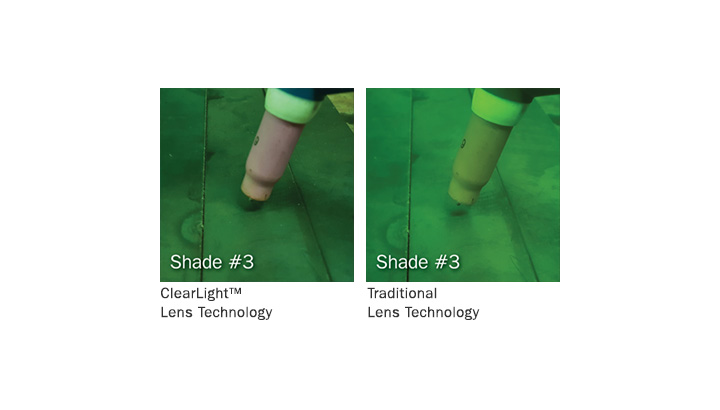
One of the most notable innovations is Miller’s ClearLight Lens Technology. This advanced lens design improves visibility by allowing a broader range of colors to pass through the filter, giving welders a clearer, more natural view of both the weld pool and surrounding workpiece. The result is not just better accuracy but also reduced eye strain during non-welding tasks. Operators can leave their helmets down while performing pre-weld setups or finishing work, increasing both efficiency and continuous protection.
Benefits for Safety and Productivity
Welding eye injuries remain a significant concern. According to the U.S. Consumer Product Safety Commission, over 15,000 welding-related eye injuries occur annually, accounting for roughly 25% of all injuries to welders. Studies suggest that up to 90% of these injuries are preventable. Many accidents happen when operators raise their helmets for better visibility during non-welding tasks.
ClearLight Lens Technology addresses this issue by providing a brighter light state and heightened clarity. Welders can confidently keep their helmets down while grinding, cleaning, or performing setup work—tasks that previously required lifting the helmet. Beyond safety, this improved visibility can enhance productivity, reduce rework, and contribute to higher-quality welds.
Seeing More Colors
Traditional auto-darkening lenses often restrict certain wavelengths, producing an artificial yellow, green, or blue tint. ClearLight Lens Technology uses a wide-band filter that lets more colors pass through, creating a more color-neutral view of the weld. This allows operators to better distinguish the weld pool and surrounding materials, improving precision and reducing mistakes. Even when not welding, the enhanced color contrast makes it easier to see peripheral objects, promoting “helmet-down” time and consistent protection.
A Brighter Light State
The “light state” of an auto-darkening lens refers to its level of transparency when not darkened. ClearLight lenses provide a light state of three, brighter than many conventional lenses (which typically start at four). This brighter state improves visibility between welds, reduces eye strain, and minimizes the need to lift the helmet—especially important for comfort and safety as welders age.
Additional Considerations
While lens technology is critical, other helmet features also affect comfort and productivity. Proper balance and weight distribution reduce neck strain and allow for longer arc-on periods. Flexible headgear that conforms to an operator’s head shape minimizes pressure points, headaches, and discomfort.
Choose a Helmet That Goes Beyond the Basics
Investing in a welding helmet with ClearLight Lens Technology gives welders a clearer, more accurate view of their work while reducing eye strain. A brighter light state, broader color spectrum, and ergonomic design improve safety, operator comfort, and productivity. When selecting your next welding helmet, consider features like ClearLight lenses to maximize performance and protection on every weld.
When to Use Air Fed Welding Helmets
In environments with high fume exposure, welders may require air-fed welding helmets.
These helmets integrate a powered air-purifying respirator (PAPR) system to deliver filtered air while welding.
Air-fed helmets are particularly useful for:
- Stainless steel welding
- Confined spaces
- Heavy fabrication workshops
- Industrial welding environments
You can view professional air-fed systems here
These helmets combine respiratory protection with standard lens shade protection for maximum safety.
Correct Welding Helmet Shade Guide
Choosing the correct lens shade involves more than simply following a welding shade chart. Experienced welders consider several additional factors.
Start Darker Than Needed
A common rule of thumb is to begin with a shade that is slightly too dark and gradually move lighter until you achieve good visibility without compromising protection.
This ensures you never accidentally expose your eyes to excessive light.
Consider Your Welding Process
Different welding processes produce different levels of arc brightness.
General guidelines include:
- MIG welding: Shade 10–12
- TIG welding: Shade 9–12
- Stick welding: Shade 11–13
- Plasma cutting: Shade 6–10
Check Your Amperage
Higher amperage welding produces more intense arc light.
As amperage increases, your helmet shade should increase accordingly.
Choose Quality Optics
Poor optical clarity can make welding more difficult even if the shade level is correct.
High-quality helmets offer:
- True colour technology
- Distortion-free viewing windows
- Adjustable sensitivity and delay settings
Many modern helmets are built with premium polycarbonate lenses to provide clear, distortion-free vision.
Maintaining Your Welding Helmet Lens
Even the best helmet will lose effectiveness if the lens becomes scratched or damaged.
Lens covers and filters should be replaced regularly to maintain protection and clarity.
You can browse replacement lenses here.
Signs your lens should be replaced include:
- Scratches affecting visibility
- Discolouration
- Slow auto-darkening response
- Cracked lens covers
Regular maintenance ensures both safety and productivity.
Common Welding Shade Mistakes
Many welders unknowingly use the wrong shade lens.
Common mistakes include:
- Using a shade that is too light – This can lead to eye strain and arc eye injuries.
- Using a shade that is too dark – This makes it difficult to see the weld puddle and reduces weld accuracy.
- Ignoring amperage changes – A higher current requires a darker shade.
- Using damaged lenses – Scratched or cracked lenses reduce both visibility and protection.
Following a proper welding helmet shade guide helps avoid these problems.
For more information on the correct guidelines with welding safety see the HSE website here
FAQ: Welding Helmet Shade Guide
What shade lens is best for MIG welding?
For most MIG welding jobs, a shade 10–12 lens works well. Lower amperage work may use shade 10, while higher currents require shade 11 or 12.
What shade lens should I use for TIG welding?
TIG welding generally uses shades 9–12 depending on amperage. Lower current TIG welding can often be done comfortably with shade 9 or 10.
Is a darker welding lens always safer?
Not necessarily. While darker lenses provide more protection, they can make it difficult to see the weld puddle. The goal is to find the darkest shade that still allows clear visibility.
Are auto-darkening helmets better than fixed shade helmets?
For most welders, yes. Auto-darkening helmets improve efficiency, reduce neck strain, and allow better visibility before striking the arc.
How do I know if my welding helmet lens is too light?
If you experience eye discomfort, flashing spots, or difficulty focusing after welding, your lens shade may be too light.
Do all welding helmets support multiple shades?
No. Fixed shade helmets have one shade level, while auto-darkening helmets allow adjustable shade ranges.
Final Thoughts
Choosing the correct lens shade is essential for both safety and welding performance. By following a proper welding shade chart and selecting a helmet that suits your welding process, you can protect your eyes while achieving better weld quality.
Whether you are working with MIG, TIG, or stick welding, investing in a high-quality helmet with the correct shade range will significantly improve your welding experience.
If you are looking for professional welding helmets, replacement lenses, or air-fed systems, you can explore the full range of equipment available at Norsemen Safety here.
With the right helmet shade guide and equipment, you can weld safely, comfortably, and with complete confidence.