
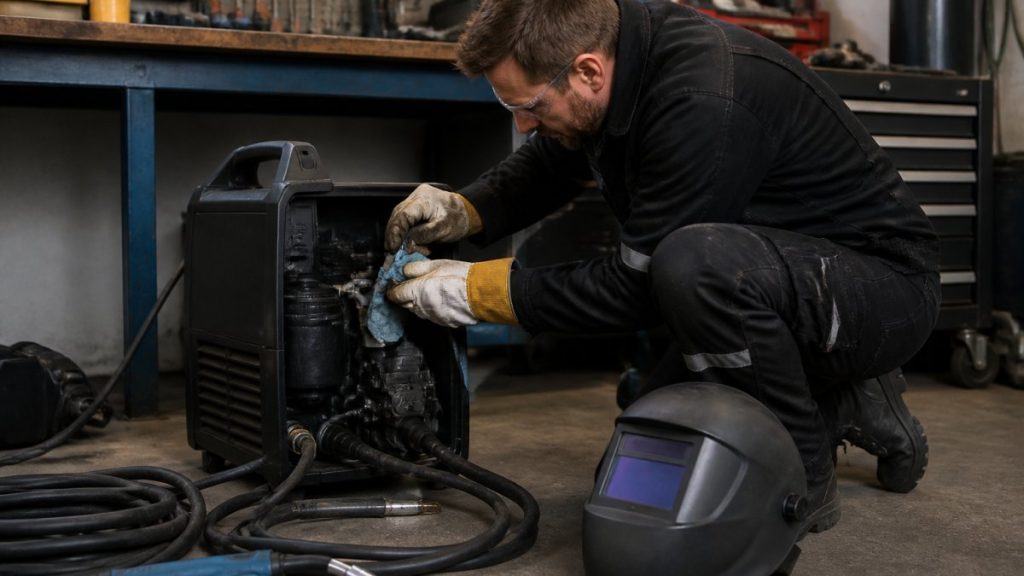
Last Updated: 25 October 2026
Quick Summary
Welding equipment maintenance involves daily visual inspections, weekly checks of consumables and connections, and monthly servicing of internal components and systems. Proper welding equipment maintenance prevents breakdowns, ensures consistent arc quality, and extends equipment life far beyond neglected alternatives.
- Replace contact tips weekly when arc quality drops or spatter increases to maintain consistent penetration
- Clean gas nozzles after every shift and check torch liners monthly for cracks or damage
- Schedule professional servicing annually at minimum, with heavy users servicing twice yearly for calibration and internal component testing
- Store equipment in dry conditions and avoid damp environments to prevent corrosion and electrical problems
- Follow manufacturer maintenance intervals specified in your equipment manual rather than skipping recommended procedures
Table of Contents
- Why welding equipment maintenance matters
- Creating your welding machine maintenance checklist
- MIG welder maintenance: what to do weekly and monthly
- Welding torch maintenance: keeping the heat consistent
- How often should you service your welding machine?
- Common maintenance mistakes that damage equipment
- Getting your welding equipment serviced professionally
- Frequently Asked Questions
Why welding equipment maintenance matters
Proper welding equipment maintenance is the difference between a productive workshop and one plagued by downtime. When your machines fail mid-project, you lose time, money, and client trust. Equipment that’s well-maintained performs consistently and lasts years longer than neglected alternatives.
Teams that follow structured maintenance schedules report fewer breakdowns. Their equipment delivers cleaner welds and better arc quality. The cost of preventive maintenance is tiny compared to emergency repairs or equipment replacement.
Neglect creates a cascade of problems. Worn contact tips produce inconsistent arc starts. Damaged liners cause wire feeding issues. Corroded connections create resistance and heat loss. Each small problem compounds into bigger failures that grind your workflow to a halt.
The real cost isn’t just downtime. It’s the quality issues that slip through. Poor arc performance means rework, rejected parts, and damaged reputation. A few hours of maintenance per month prevents all of this.
Creating your welding machine maintenance checklist
A maintenance checklist keeps you accountable and systematic. You won’t skip steps or forget critical inspections. The best checklist is one you actually use, so keep it simple and specific to your equipment.
Professional technician inspecting welding machine connections and cables with multimeter, maintenance checklist on clipboard on metal workbench with tools
Your checklist should cover three time periods: daily, weekly, and monthly. Daily checks catch problems before they affect your work. Weekly inspections identify wear patterns early. Monthly servicing keeps everything in peak condition.
Daily checks before you weld
Start every shift with a quick visual inspection. Look for obvious damage, loose connections, or unusual wear. Check that all safety guards are in place and functioning. Verify gas flow and pressure settings match your job requirements.
Run a test weld on scrap material. Listen for unusual sounds. Watch the arc behaviour. If something feels off, investigate before starting production work.
Weekly and monthly inspections
Weekly inspections go deeper. Check all cable connections for corrosion or damage. Inspect the earth clamp for clean contact. Look at your consumables: contact tips, liners, nozzles. Replace anything showing wear.
Monthly servicing includes:
- Cleaning internal components if your machine allows access
- Checking all bolts and fasteners are tight
- Testing voltage and amperage output against manufacturer specs
- Inspecting the cooling system if your machine has one
- Reviewing consumable wear patterns to predict replacement timing
MIG welder maintenance: what to do weekly and monthly
MIG welders demand regular attention to consumables and wire feed systems. These machines are workhorse equipment, but they’re only reliable when maintained properly. The contact tip, liner, and drive rollers wear constantly and need monitoring.
Check your contact tip weekly. A worn tip produces erratic arc starts and inconsistent penetration. If you’re seeing spatter or unstable arcs, the tip is likely the culprit. Replace it before quality suffers.
Inspect your wire liner for damage. Pull the wire back and look inside the liner for cracks or debris. A damaged liner causes wire feeding problems and arc instability. Replace it if you see any damage.
Clean your drive rollers monthly. Wire dust accumulates and creates drag. Use a soft brush to remove buildup. Check that roller pressure is correct for your wire diameter. Too much pressure flattens the wire; too little causes slipping.
Check your gas flow rate weekly. A clogged gas nozzle reduces shielding gas coverage. Clean the nozzle with a soft brush. Verify your regulator shows steady pressure. Fluctuating pressure indicates a regulator problem that needs professional attention.
Examine your work clamp and earth cable. Corrosion at the clamp reduces electrical contact and causes arc problems. Clean it with a wire brush. If corrosion is severe, replace the clamp.
[PAGES LINK: You can explore MIG welder options to understand what equipment you’re maintaining.]
Welding torch maintenance: keeping the heat consistent
Welding torch maintenance is critical for arc quality and consumable life. Your torch takes the most abuse in your welding system.
For MIG torches, the contact tip is your first maintenance point. It erodes with every weld. A worn tip creates resistance and heat buildup.
The gas nozzle directs shielding gas to your arc. Spatter builds up inside and blocks gas flow. Clean your nozzle after every shift.
Check your torch liner regularly. It guides the wire and carries electrical current. A damaged liner causes wire feeding problems and electrical resistance. Look for cracks, burns, or deformation.
Inspect your torch cable for damage. Cracks in the insulation expose live electrical conductors. Check for burns or melted sections.
For TIG torches, the consumables are different but equally important. Your tungsten electrode wears with use. Replace it when it becomes too short or develops a ball at the tip.
[PAGES LINK: MIG torch products and spares and TIG torch spare parts are available to support your maintenance routine.]
The collet and collet body hold your tungsten and need regular cleaning. Tungsten dust accumulates and creates resistance. Clean them monthly with a soft brush.
Your TIG torch cup directs gas flow. Like MIG nozzles, it collects spatter and needs regular cleaning. Use a soft brush and be gentle.
How often should you service your welding machine?
The frequency depends on your usage and equipment type. Light users might service quarterly. Heavy production shops should service monthly or even weekly. The key is consistency and attention to what your equipment tells you.
Seasonal servicing schedules
Seasonal changes affect your equipment. Summer heat increases cooling demands. Winter cold affects gas pressure and electrical conductivity. Plan maintenance around these seasonal shifts.
Spring is ideal for deep cleaning. Remove dust and debris accumulated over winter. Check all connections for corrosion. Test your cooling system if your machine has one.
Summer requires attention to cooling. If your machine has a fan, verify it runs smoothly. Check that vents are clear. Monitor amperage output to ensure the machine isn’t overheating under heavy use.
Autumn is the time to prepare for winter. Check that your gas lines aren’t kinked or damaged. Verify regulator function. Test your machine’s cold-weather performance before heavy winter work begins.
Winter maintenance focuses on condensation and cold-related issues. Gas pressure drops in cold weather. Regulator performance changes. Keep your workspace dry to prevent moisture in your gas lines.
Signs your machine needs professional servicing
Some problems require professional attention. If your machine won’t hold a stable arc despite fresh consumables, the power supply may need calibration. If voltage output is erratic, internal components may be failing. If the machine overheats quickly even at normal amperage, cooling systems may be blocked or failing.
Listen for unusual sounds. A grinding noise suggests bearing problems. A buzzing sound that changes with amperage indicates transformer issues. Loud cooling fan noise might mean the fan is failing.
Watch for performance changes. If you’re getting inconsistent penetration despite identical settings, something internal has shifted. If arc quality deteriorates gradually over weeks, internal components are wearing.
Temperature problems warrant professional service. If the machine gets too hot too quickly, cooling isn’t working properly. If it’s cold to the touch even under load, the transformer may be failing.
Maintenance frequency and seasonal considerations depend on your usage patterns and climate.
|
Season |
Key maintenance focus |
Specific tasks |
|---|---|---|
|
Spring |
Deep cleaning and corrosion check |
Remove winter debris, check connections, test cooling system |
|
Summer |
Cooling system performance |
Verify fan operation, clear vents, monitor amperage |
|
Autumn |
Winter preparation |
Check gas lines, verify regulator function, test cold-weather performance |
|
Winter |
Condensation and cold-related issues |
Monitor gas pressure changes, keep workspace dry, prevent moisture in gas lines |
Common maintenance mistakes that damage equipment
The biggest mistake is ignoring small problems. A worn contact tip seems minor. Ignoring it means the arc becomes unstable. That instability stresses the power supply. What started as a consumable issue becomes an expensive repair.
Never skip consumable replacement. People stretch contact tips, liners, and nozzles way past their useful life. “I’ll replace it when it completely fails” costs you quality and equipment life. Replace consumables before they fail.
Avoid using the wrong gas. Different applications need different gases. Using the wrong gas produces poor shielding and can damage your equipment. Always verify your gas type matches your application.
Don’t ignore corrosion. Corroded connections reduce electrical flow and create heat. That heat damages components. Clean corrosion immediately. If it returns quickly, investigate the source.
Never work around safety issues. A cracked torch cable isn’t just a safety hazard. It’s an electrical problem that stresses your power supply. Fix it immediately.
Avoid storing equipment in damp conditions. Moisture causes corrosion and electrical problems. Store your equipment in a dry space. If you work in humid environments, run your machine periodically to warm internal components and drive out moisture.
Don’t skip manufacturer recommendations. Your equipment manual specifies maintenance intervals and procedures for a reason. Follow them. They’re based on how the machine is designed to function.
Getting your welding equipment serviced professionally
Professional servicing goes beyond what you can do in your workshop. Learn about Miller welding equipment to understand the tools you’re maintaining and how professional servicing keeps them performing optimally. Technicians have calibration equipment to verify output specifications. They can test internal components you can’t access. They catch problems before they become catastrophic failures.
Schedule professional service annually at minimum. Heavy users should service twice yearly. Professional technicians will:
- Calibrate voltage and amperage output
- Test all safety systems
- Clean internal components
- Replace worn internal parts
- Test cooling systems
- Verify earthing and electrical safety
Choose a technician who knows your equipment brand. Different manufacturers have different designs and requirements. A technician experienced with your specific machine model will service it correctly.
Keep service records. Document what was serviced, when, and by whom. These records help you spot patterns. If a component fails repeatedly, something else may be causing the problem.
Don’t delay professional service. Small electrical or cooling issues become expensive repairs if ignored. A machine that’s starting to overheat needs attention now, not when it fails completely.
Professional servicing costs less than downtime. A day of professional maintenance prevents weeks of equipment failure. The investment pays for itself in productivity and equipment life.
Frequently Asked Questions
How often should welding equipment be serviced?
Most welding equipment needs professional servicing annually, though heavy-use machines may require servicing every six months. Daily visual checks, weekly cable inspections, and monthly deep cleans extend the time between services. Refer to your machine’s manual for manufacturer recommendations, as duty cycles and environment affect frequency. Track servicing dates to stay compliant with workplace safety requirements.
What should be included in a welding machine maintenance checklist?
A complete welding machine maintenance checklist covers cable insulation, electrical connections, cooling system function, gas flow settings, contact tips, and nozzle condition. Check for corrosion, loose bolts, and debris inside the machine. Inspect the power cord for damage and verify earth connections are secure. Document all findings so you catch wear patterns early and prevent unexpected downtime on site.
What are the signs that a welding machine needs servicing?
Watch for inconsistent arc quality, spatter buildup, difficulty striking an arc, and unusual noises or vibrations. Overheating during normal use, weak gas flow, or visible corrosion inside the machine all signal it’s time for professional servicing. Poor weld appearance despite correct settings often points to worn contact tips or internal contamination. Don’t wait for complete failure; catching these early keeps your team productive.
Can poor maintenance affect weld quality?
Yes. Worn contact tips, blocked gas nozzles, and corroded cables all degrade weld consistency and appearance. Dirty or damaged equipment produces weak arcs, spatter, and incomplete fusion. Poor maintenance also increases safety risks, including electrical hazards and gas leaks. Regular maintenance ensures stable arc characteristics and meets quality standards for structural work, pipework, and fabrication.
Welding equipment maintenance is an investment in reliability and safety. Consistent maintenance keeps your machines running smoothly and your welds clean. When you’re ready to upgrade or expand your equipment, Norsemen Safety stocks professional-grade welding machines and consumables from trusted brands. Shop now for the equipment and supplies that keep your workshop productive.