
Last Updated: 26 October 2026
Quick Summary
MMA vs MIG welder differs fundamentally in how they operate: MMA uses a consumable flux-coated electrode you manually feed, whilst MIG uses continuous wire feed from an external gas cylinder. MIG is faster and easier for beginners, but MMA performs better outdoors and in harsh weather conditions.
- MIG is generally easier for beginners and produces acceptable welds within hours rather than days.
- MMA is more forgiving outdoors because flux coating creates its own shielding, unaffected by wind or moisture.
- MIG excels with thin materials down to about 0.5mm without burn-through, whilst MMA struggles with very thin sheet metal.
- MIG requires gas cylinders and more consumables, adding ongoing costs compared to MMA’s simpler electrode-only setup.
- Many professional shops use both processes because each has genuine advantages for different applications.
Table of Contents
- How MMA and MIG Welders Work Differently
- MMA or MIG Welder for Beginners: Which Is Easier to Learn
- Speed and Efficiency: MMA vs MIG Welder Performance
- MMA vs MIG for Outdoor Welding: Weather and Environment
- MIG vs MMA for Thin Metal: Material Thickness and Precision
- Choosing an MMA and MIG Welding Machine for Your Workshop
- Finding the Right Welder for Your Next Project
- Frequently Asked Questions
How MMA and MIG Welders Work Differently
MMA and MIG welders operate on fundamentally different principles, which shapes everything from ease of use to output quality. Understanding these core differences is essential before deciding whether an MMA vs MIG welder suits your work.
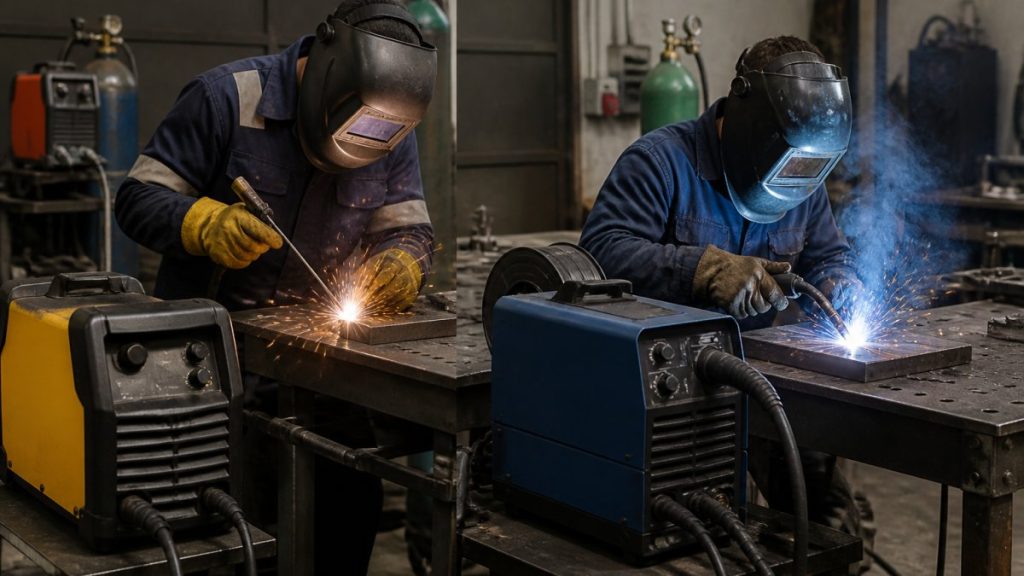
MMA (Manual Metal Arc) welding, also called stick welding, uses a consumable electrode coated in flux. You manually feed the electrode toward the workpiece as it melts. The flux coating creates a shielding gas that protects the weld pool from atmospheric contamination. This is a relatively simple process mechanically, but it demands steady hand control and consistent technique.
MIG (Metal Inert Gas) welding, by contrast, uses a wire electrode fed continuously through a torch. The shielding gas comes from an external cylinder rather than from the electrode coating. This continuous feed means less stopping and starting, which fundamentally changes how the process feels to operate.
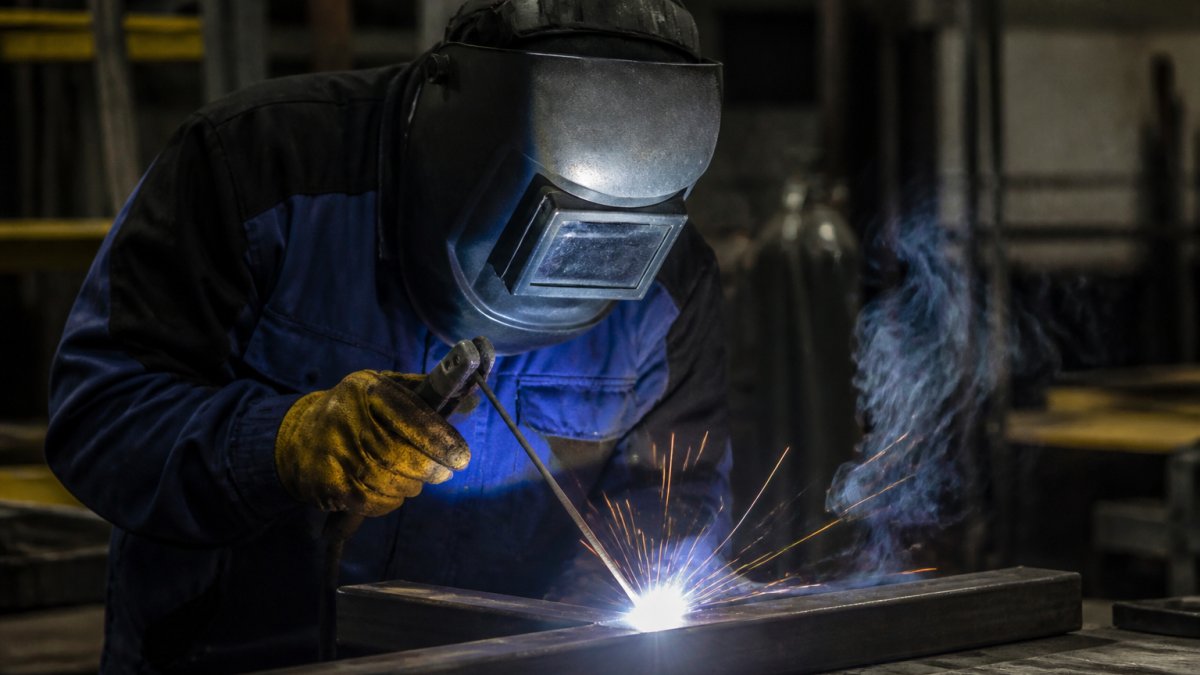
The practical difference matters. With MMA, you’re managing the electrode length constantly, it gets shorter as you weld, so you’re adjusting your hand position continuously. With MIG, the wire feeds at a steady rate, so your torch position remains more stable. For someone learning to weld, this distinction between manual electrode management and automatic wire feed changes the difficulty curve significantly.
Both processes can produce strong, reliable welds when executed properly. The choice between an MMA welder and a MIG welder depends on what you’re welding, where you’re welding it, and how much control you need over the process.
MMA and MIG welders operate on fundamentally different principles that shape their practical use.
| Aspect | MMA (Stick) | MIG |
|---|---|---|
| Electrode | Consumable, flux-coated | Continuous wire feed |
| Shielding gas source | Flux coating on electrode | External cylinder |
| Hand management | Adjust position as electrode shortens | Torch position remains stable |
| Stopping and starting | Frequent electrode changes | Continuous operation |
MMA or MIG Welder for Beginners: Which Is Easier to Learn
If you’re new to welding, MIG is generally easier to pick up quickly. The continuous wire feed and simpler gun operation mean you can produce acceptable welds within hours rather than days.
MMA has a steeper initial learning curve. You’re managing electrode angle, travel speed, and arc length simultaneously. Your hand gets tired faster because you’re holding a heavier electrode holder at a precise angle for extended periods. The electrode stub left behind also means frequent stops to change electrodes, breaking your rhythm.
That said, MMA teaches fundamental welding principles more thoroughly. Once you master stick welding, transitioning to other processes becomes straightforward. Many welders consider MMA the better foundation despite the harder start.
Explore arc welders and MIG welding equipment to see beginner-friendly options. At Norsemen Safety, we stock machines suited to different experience levels, with support available to help you choose the right equipment for your skill level and intended applications.
Speed and Efficiency: MMA vs MIG Welder Performance
MIG welding is faster. The continuous wire feed eliminates electrode changes, and you can travel along a seam without interruption. For long runs or high-volume production, MIG saves significant time.
MMA requires more stops to change electrodes, particularly on longer welds. You also spend time cleaning slag (the hardened flux coating) from each bead before the next pass. These interruptions add up on larger projects.
However, “faster” doesn’t always mean “better.” MMA’s slower pace can actually be an advantage in certain situations. The controlled nature of the process gives you finer control over heat input, which matters when welding thinner materials or in positions where heat management is critical.
For shop work where throughput matters, MIG typically wins on efficiency. MIG equipment and accessories are designed to maximise this advantage with features that support continuous operation and faster setup between jobs.
MMA vs MIG for Outdoor Welding: Weather and Environment
Weather affects these processes differently. MIG is sensitive to wind and humidity. The shielding gas can be blown away from the weld pool, allowing oxygen and nitrogen to contaminate the bead. Even moderate wind can degrade weld quality with MIG. Rain and moisture in the air also cause problems.
MMA is far more forgiving outdoors. The flux coating creates its own shielding, so wind doesn’t disrupt protection. You can weld in damp conditions that would make MIG impractical. This is why MMA remains the default choice for field work, site welding, and remote locations where environmental control isn’t possible.
If your work takes you outside regularly, an MMA welder is the more reliable choice. The process simply works in conditions where MIG struggles.
MIG vs MMA for Thin Metal: Material Thickness and Precision
MIG excels with thin materials. The process delivers lower heat input and allows precise control over penetration. You can weld sheet metal down to about 0.5mm without burn-through. The continuous feed also makes it easier to maintain consistent bead appearance on delicate work.
MMA struggles with very thin materials. The electrode itself is relatively thick, and controlling heat input precisely is harder. You risk burning through thin sheet metal or creating weak welds with insufficient penetration.
For precision work on thin gauge materials, MIG is the better choice. It’s what fabricators and sheet metal specialists use because it gives them the control they need.
Conversely, if you’re welding heavy structural steel or thick plates, both processes work well. MMA can actually be preferable here because it delivers deeper penetration and you have more tactile feedback about what’s happening in the weld pool.
Choosing an MMA and MIG Welding Machine for Your Workshop
Selecting between an MMA welder and a MIG welder depends on your typical work. Consider what materials you weld most often, where you work, and how much production volume you need to handle.
For general-purpose fabrication shops, many teams keep both. MIG handles the high-volume work and thin materials efficiently. MMA covers outdoor jobs, field repairs, and situations where environmental conditions make MIG unreliable.
If you’re buying your first machine, your budget and available space matter as much as process choice. MIG equipment requires gas cylinders and more consumables, which adds ongoing costs. MMA is simpler, you just need electrodes and a power source.
Understanding the difference between air-cooled and water-cooled equipment also affects your decision, particularly if you’re running extended welding sessions. Read more about air-cooled versus water-cooled MIG welding to see which cooling approach suits your workshop setup and duty cycle.
For electrode selection once you’ve chosen your process, foundational guidance on choosing welding electrodes helps ensure you’re using the right consumables for your application.
Finding the Right Welder for Your Next Project
The MMA welder versus MIG welder decision ultimately comes down to matching the process to your specific work. Neither is objectively “better”, they’re built for different jobs.
MIG wins for speed, thin materials, and indoor fabrication work. MMA wins for outdoor durability, thick materials, and field conditions. Many professional shops use both because each has genuine advantages in particular situations.
At Norsemen Safety, we supply high-quality welding equipment from trusted manufacturers, along with the consumables and safety gear you need to work effectively. Our team can help you evaluate your typical projects and recommend equipment that matches your actual requirements. Whether you’re setting up a new shop or adding capacity to an existing operation, we stock the machines and support to get you working safely and productively.
Frequently Asked Questions
What is the main difference between MMA and MIG welding?
MMA (Manual Metal Arc) uses a consumable electrode that melts into the weld, while MIG (Metal Inert Gas) feeds a wire continuously through a gun. MMA requires more operator skill and produces stronger welds on thicker materials, but is slower. MIG is faster, easier to learn, and better for thinner metals and production work. Each suits different applications and materials.
Is MMA or MIG welder better for beginners?
MIG is generally easier for beginners because it has simpler technique and faster learning curve. However, MMA teaches better fundamental arc control and is invaluable for outdoor or site work where portability matters. Many professionals learn MIG first for speed, then add MMA skills for versatility. Your choice depends on the work you expect to do most often.
Which welder is better for outdoor welding, MMA or MIG?
MMA is superior for outdoor welding. It performs reliably in wind, rain, and poor visibility because the flux coating protects the weld pool independently. MIG requires a shielding gas that wind can easily disrupt, making it unsuitable for exposed sites. If you work on construction sites or remote locations, MMA is the practical choice despite requiring more skill.
Can one welding machine do both MMA and MIG?
Yes, some dual-process machines can perform both MMA and MIG welding with different torches and wire feed attachments. These are versatile for workshops handling mixed work, but they cost more than single-process machines. For professionals needing both capabilities regularly, a dual-process machine eliminates buying separate equipment. Check compatibility before purchasing to ensure both processes meet your quality standards.
Getting the right equipment means understanding not just the process, but how it fits into your workflow, your environment, and your budget. The difference between choosing well and choosing poorly can mean the difference between a job that flows smoothly and one that creates frustration and rework. Start with clarity about what you actually weld, then select the tool that does that work best.