Need help? Call us: 028 9046 0541 or info@norsemensafety.co.uk

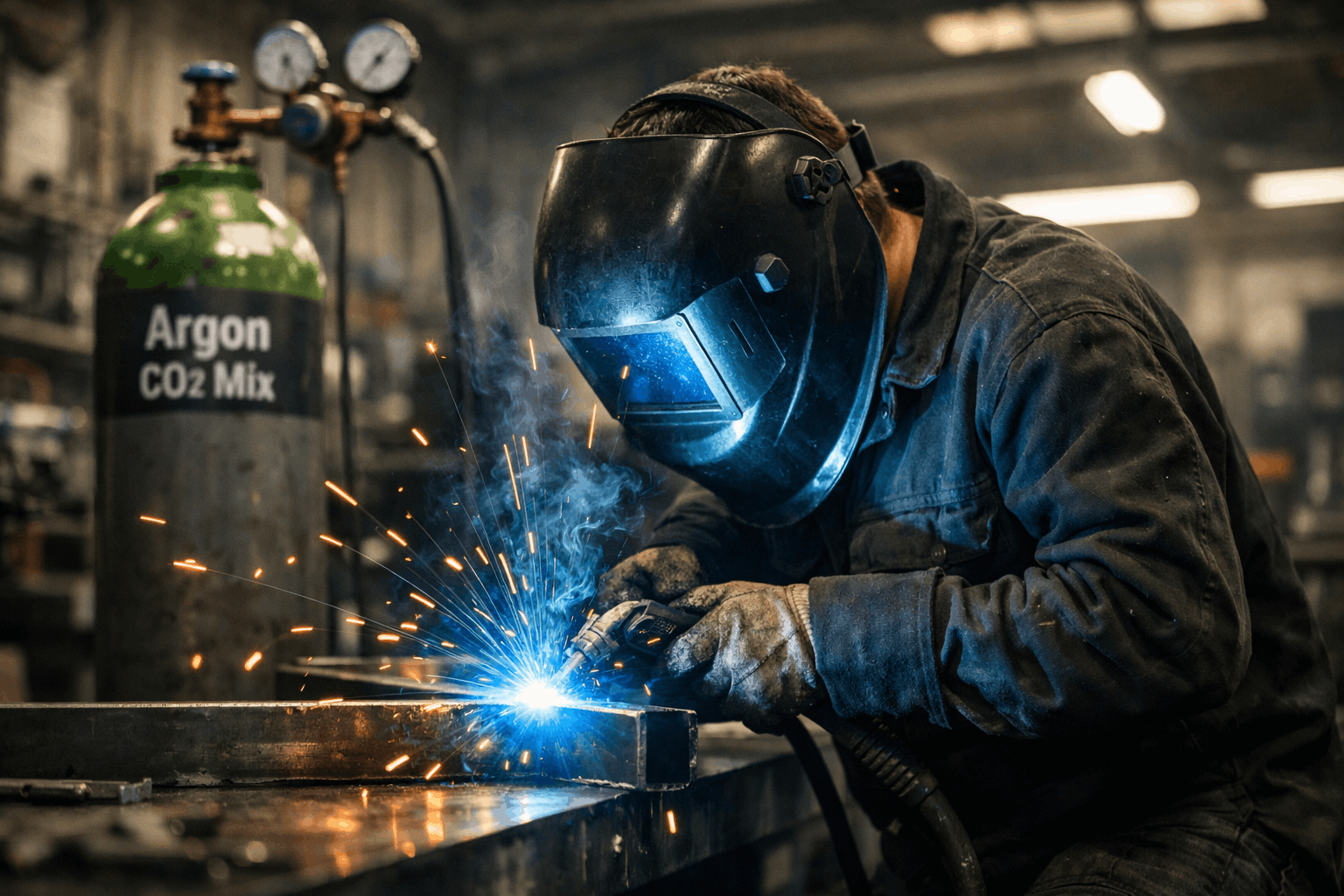
If you’ve ever asked yourself, what gas do you use for MIG welding?, you’re not alone. Choosing the correct MIG welding gas is one of the most important decisions you’ll make as a welder. The right shielding gas improves arc stability, reduces spatter, increases penetration control, and gives you a cleaner, more professional finish.
In this complete UK guide, We’ll explain the different MIG gas types, when to use an argon CO2 mix, and how to match your gas to the right wire and application.
MIG welding uses a shielding gas to protect the molten weld pool from atmospheric contamination. Without proper shielding, oxygen and nitrogen enter the weld, causing porosity, brittleness, and weak joints.
The correct MIG welding gas will:
Using the wrong gas leads to poor results, wasted materials, and frustration.
There are three primary MIG gas types commonly used in the UK:
Each has its place depending on material type, thickness, and finish requirements.
Pure carbon dioxide is one of the most cost-effective MIG welding gas options available. It’s commonly used for heavier steel fabrication where deep penetration is required.
Pure CO2 works well for structural steel and heavier fabrication jobs. If you’re welding thicker mild steel, pairing CO2 with a strong wire such as Elga Megafil 713R Seamless Flux Cored Mig Wire
If you would like to order CO2 for your workshop, contact us via our Contact Us page or call 02890460541 and we can direct you where to buy.
The argon CO2 mix is by far the most commonly used MIG welding gas in the UK. It provides the best balance between penetration and weld appearance.
Typical mixes include:
For general mild steel welding, 75/25 or 80/20 argon CO2 mix is ideal.
Argon stabilises the arc and significantly reduces spatter. The CO2 portion increases penetration and improves fusion.
If you’re welding automotive panels, gates, trailers, or general workshop projects, this is usually the best MIG welding gas option.
For optimal gas control and efficiency, consider using a high-quality regulator such as:

This Optimator Argon-Mix Regulator is a high performance multi-stage regulator with built-in economizer and flow meter.
It is mostly used for mig welding applications, where it will reduce the total welding cost by decreasing the gas consumption by up to 50%.
In addition, reduced porosity sensitivity improves weld quality. The regulator’s two stage function will give stable gas flow even when the cylinder pressure drops.
We direct you to source argon CO2 mix directly. To arrange gas supply, visit our Contact Us page or call 02890460541.
Gasless MIG welding uses flux-cored wire instead of external shielding gas. The flux inside the wire creates its own protective atmosphere.
This is ideal for:
For gasless welding, consider:
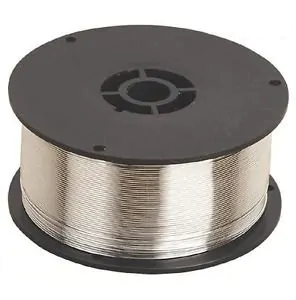
Self Shielded Mig Wire 0.8mm is a E71T-GS self-shielding steel MIG wire . This self shielding wire is ideal for DIY, Automotive repairs and maintenance applications use. You do not need to use gas with mig welding with E71T-GS.
Remember : Select electrode polarity. Flux-cored welding requires DC electrode negative, or straight polarity.
Available in other sizes Call us if you need more information 028 9046 0541
AVAILABLE ON .45KG, 1 KG and a 4.5KG spool select spool size above.
Self-shielded flux-cored welding can be an excellent process to use for welders of all skill levels who frequently need to weld outside or on dirty material. The E71T-GS self-shielding is the best wire for gasless mig welder.
Your shielding gas and wire must work together.
For example:
If you’re unsure which combination is best, contact us via our Contact Us page or call 02890460541
Correct flow rate is just as important as choosing the right MIG gas type.
Typical indoor settings:
10–15 litres per minute
Too much flow wastes gas. Too little causes porosity.
For reliable performance, use a proper regulator such as:
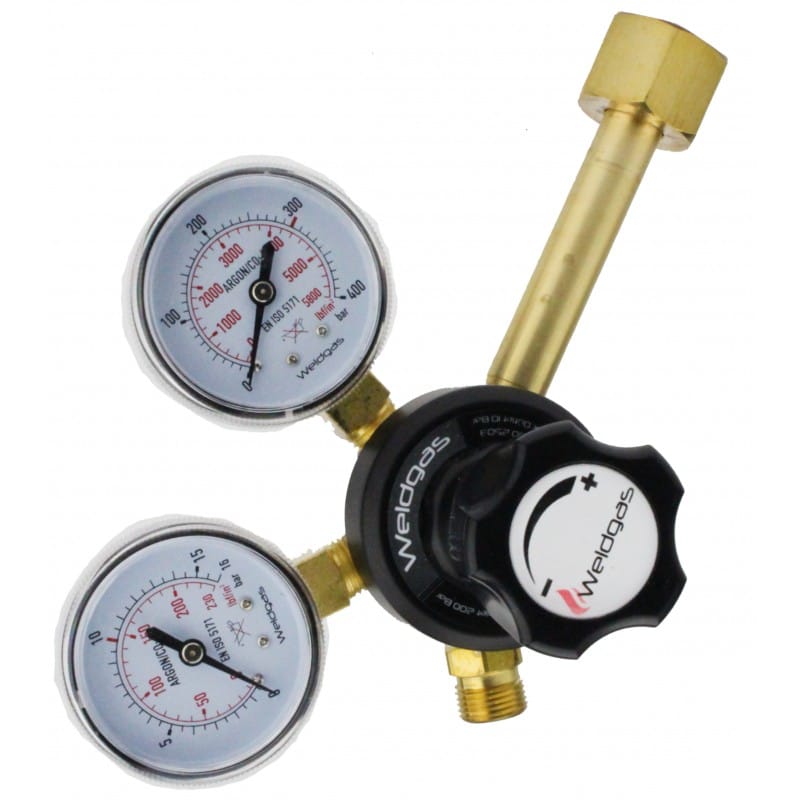
CO2 Regulator Single Stage with 2 gauges 10 Bar Side Entry If you are looking to reduce your mig welding gas costs CO2 is an option.
Carbon Dioxide (CO2) is a very common reactive gases used in MIG welding and the only one that can be used in its pure form without the addition of an inert gas. CO2 is also the least expensive of the common shielding gases, making an attractive choice when material costs are the main priority.
or

Argon Regulators Single Stage with one gauge is designed to step the pressurised contents of a compressed gas cylinder down to a pressure that can be used in Argon/CO2 Shielded MIG / TIG welding. Everyday Gas Regulators are a bottom entry design which are suited for top outlet cylinder valves. With a flow rate of up to 96m³/h and a full 300 Bar Capacity, they are the industry’s choice.
Good gas control reduces costs and improves weld quality.
Wind is the biggest enemy of shielding gas.
Indoor welding: Standard argon CO2 mix works perfectly.
Outdoor welding: Shielding gas can blow away.
Solutions:
Avoiding these mistakes will dramatically improve weld consistency.
When working with MIG welding gas, it’s essential to follow Health and Safety Executive (HSE) guidance to protect yourself and others in the workplace. Welding fumes and shielding gases can present serious health risks if not properly controlled.
Below is a summary of key HSE recommendations relevant to MIG welding operations.
The HSE states that all welding fumes, including those from mild steel, are potentially harmful and must be controlled under the Control of Substances Hazardous to Health (COSHH) Regulations.
This applies whether you are using an argon CO2 mix, pure CO2, or any other MIG gas types.
Employers and workshop operators must:
The HSE requires adequate ventilation for all welding processes. Even when using MIG welding gas correctly, shielding gases can displace oxygen in confined spaces, creating an asphyxiation risk.
Key recommendations include:
Where engineering controls cannot fully eliminate exposure, suitable RPE must be provided.
This is particularly important when:
RPE must be:
MIG welding gas cylinders must be handled and stored safely. This includes argon CO2 mix cylinders and pure CO2 bottles.
HSE guidance recommends:
Improper storage of shielding gases can lead to serious incidents.
If welding in tanks, containers, or enclosed spaces, shielding gases can displace oxygen and create a life-threatening environment.
Additional controls may include:
Following HSE guidance is not just about legal compliance — it protects your health long term. Welding fume exposure has been linked to serious respiratory conditions and occupational asthma.
Whether you are using pure CO2, an argon CO2 mix, or specialist MIG gas types, always ensure:
If you need advice on safe gas handling or suitable regulators for your setup, contact us via our Contact Us page.
When you contact us, we can:
An 80/20 argon CO2 mix is ideal. It offers smooth arc control and clean welds.
Yes, but expect more spatter and a rougher finish. It works well on thicker steel.
If using solid wire, yes. If using flux-cored wire, no external gas is required.
A low CO2 argon-based mix is recommended.
Pure argon only.
Visit our Contact Us page or call 02890460541 to arrange supply.
Choosing the correct MIG welding gas makes a huge difference to weld quality, efficiency, and finish. Whether you need pure CO2, an argon CO2 mix, or a specialist blend, using the correct shielding gas will improve your results immediately.
If you’re unsure which MIG gas types suit your project, get in touch today.
Visit our Contact Us page or call 02890460541 to arrange your MIG welding gas supply.